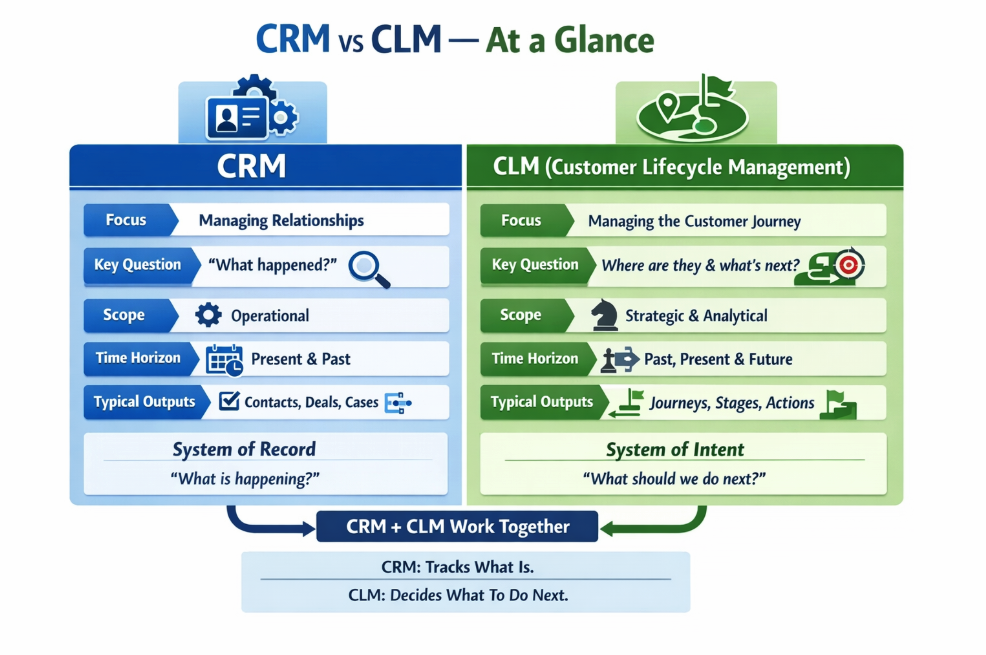
CRM vs CLM – at a glance

Here’s a clear, no-fluff comparison between CRM (Customer Relationship Management) and CLM (Customer Lifecycle Management) — because they’re related, but not the same thing.
| Aspect | CRM | CLM (Customer Lifecycle Management) |
|---|---|---|
| Primary focus | Managing relationships & interactions | Managing the entire customer journey |
| Core question | “What happened with this customer?” | “Where is this customer in their lifecycle – and what should happen next?” |
| Scope | Operational | Strategic + analytical |
| Time horizon | Mostly present & past | Past, present and future |
| Main users | Sales, Service, Marketing | Marketing, Growth, RevOps, CX |
| Typical output | Records, activities, pipelines | Journeys, stages, actions, outcomes |
What CRM actually does
CRM (Customer Relationship Management) systems are systems of record.
They excel at:
- Contact & account management
- Sales pipelines & opportunities
- Service cases & interactions
- Activity tracking (calls, emails, meetings)
Think of CRM as:
“The memory of customer interactions.”
Examples:
- Salesforce
- HubSpot
What CLM (Customer Lifecycle Management) adds
CLM is a strategy + orchestration layer that sits on top of (or across) systems like CRM.
It focuses on:
- Lifecycle stages (Lead → Customer → Loyal → At-risk → Churned)
- Transitions between stages
- Timing, triggers, and next-best actions
- Long-term value (LTV), retention, expansion
Think of CLM as:
“The playbook that decides what to do next with each customer.”
CLM typically uses data from:
- CRM
- Marketing automation
- Product usage
- Support & billing systems
Key difference in mindset
CRM mindset
“Log the interaction.”
CLM mindset
“Based on where the customer is, what should we do now to move them forward?”
How they work together (real-world example)
- CRM stores:
- Customer details
- Deals closed
- Support tickets
- CLM evaluates:
- Is this customer newly onboarded?
- Are they inactive for 30 days?
- Are they eligible for upsell?
- CLM triggers:
- Onboarding journey
- Re-engagement campaign
- Account manager task
- Retention offer
Important clarification
CLM is not usually a single product.
It’s often implemented using:
- CRM (core data)
- Marketing automation
- CDP / Data layer
- Analytics & journey orchestration
For example:
- Salesforce (CRM)
- Salesforce Marketing Cloud
- Salesforce Data Cloud
→ together enable Customer Lifecycle Management
Bottom line
- CRM = system of record
- CLM = system of intent and action
CRM tells you what is.
CLM helps you decide what to do next.
Care and share.