Enhancing Marketing ROI with Salesforce Account Engagement (Pardot) Across Tech, Healthcare & Manufacturing

As marketing budgets face increased scrutiny and buying journeys grow longer and more complex, demonstrating measurable return on investment (ROI) has become a defining mandate for modern marketing organizations. For B2B enterprises in particular – where deal sizes are large, sales cycles are extended, and multiple stakeholders influence decisions – marketing ROI depends not only on generating leads, but on nurturing, qualifying, and converting them into revenue with precision and efficiency.
Salesforce Marketing Cloud Account Engagement (formerly Pardot) was designed specifically to address these challenges. Purpose-built for B2B marketing, Account Engagement enables organizations to automate lead management, deliver personalized engagement at scale, and tightly align marketing execution with sales outcomes through native Salesforce CRM integration. When implemented correctly, it provides both operational efficiency and financial accountability – two pillars of sustainable ROI.
This paper examines how Account Engagement drives tangible ROI across three industries with distinct buyer behaviors and regulatory realities: technology, healthcare, and manufacturing. Drawing on real-world case studies and industry benchmarks, it demonstrates how organizations achieve higher conversion rates, stronger customer retention, and significant time and cost savings. In parallel, the paper provides a technical deep dive into the platform’s integration architecture, illustrating how real-time data synchronization, connected campaigns, and unified reporting create a closed-loop system that directly ties marketing activity to revenue. The insights presented are intended for CMOs, senior executives, and technical decision-makers seeking to evaluate Account Engagement not as a marketing tool alone, but as a revenue-impacting platform.
Marketing ROI and Salesforce Account Engagement
Marketing ROI measures the return on every marketing dollar spent, and improving this metric is a top priority for modern organizations. Salesforce Account Engagement (Pardot) directly targets ROI improvement by automating lead management and enabling smarter, data-driven campaigns. In fact, marketing automation platforms like Account Engagement have been shown to increase sales productivity by 14.5% while reducing marketing overhead by 12.2% on average superagi.com. These efficiency gains mean marketing teams can generate more pipeline with the same (or fewer) resources, boosting overall ROI.
One core driver of ROI is the effectiveness of email and digital campaigns. Email marketing remains one of the highest-ROI channels, averaging a 3,800% ROI (i.e. $38 return for every $1 spent) 360degreecloud.com. Account Engagement maximizes email ROI through features like automated drip nurturing, personalization, and A/B testing, which improve engagement and conversion rates. More broadly, companies that implement marketing automation experience concrete performance improvements: nurtured leads produce 20% more sales opportunities than non-nurtured leads cetdigit.com, and 84% of marketers report an increase in lead generation after adopting marketing automation cetdigit.com. Such statistics underscore that a well-implemented Account Engagement strategy can directly translate into higher marketing ROI via more opportunities and revenue.
Crucially, Account Engagement also aligns marketing and sales teams, ensuring leads are efficiently handed off and followed up. This alignment has a measurable impact on business outcomes – organizations with tightly integrated sales and marketing (often via Pardot) achieve 36% higher customer retention and 38% higher sales win rates ceptes.com. By unifying customer data and interactions in one system, Account Engagement helps marketing prove its value to the C-suite with clear attribution of marketing efforts to sales results. According to a Forrester Consulting study, Salesforce’s marketing solutions can deliver nearly 299% ROI over three years salesforce.com, driven by increased conversion rates and larger deal sizes, among other benefits. In the following sections, we explore how these ROI improvements manifest in the tech, healthcare, and manufacturing industries through real-world case studies, and then dive into the technical architecture that makes it possible.
Account Engagement ROI in the Tech Industry
Technology companies, particularly in B2B software and IT services, have embraced Account Engagement to scale their demand generation and improve marketing ROI. Tech buyers often have long research cycles, making lead nurturing and timely sales handoff critical. Pardot’s automation and Salesforce integration address these needs, as seen in the case of Redwood Software, a global enterprise software provider in the automation space.
Redwood Software implemented Pardot to unify its worldwide marketing campaigns and better track campaign ROI across regions. By integrating Pardot with Salesforce CRM, Redwood gained complete visibility into leads, opportunities, and revenue generated by each marketing campaign weare4c.com. Custom dashboards showed exactly how many leads and deals each campaign produced, enabling data-driven budget allocation. This tight integration paid off in performance: Redwood’s move from a legacy system (Marketo) to Pardot was “painless” and immediately gave their marketing team actionable insights. According to Redwood’s VP of Marketing, having prospect and email engagement data directly inside Salesforce “gives us the insight we need on which prospects and customers our sales teams need to concentrate on,” driving an efficient and effective marketing function aligned to revenue goals weare4c.com.
The quantitative results were compelling. By using Pardot to automate lead assignment and follow-up tasks, Redwood saved ~10 hours per week of manual work and saw a 15% increase in sales follow-ups by account executives weare4c.com – meaning fewer leads slipped through the cracks. Most importantly, lead conversion rates improved by 10% for both new and existing business after adopting Pardot weare4c.com, directly boosting pipeline and ROI. Dozens of other B2B tech firms report similar outcomes, with marketing automation helping achieve 20–30× ROI on campaigns relequint.com. In summary, the tech industry benefits from Account Engagement through better global campaign management, higher lead-to-sale conversion, and clearer attribution of marketing’s revenue impact.
Account Engagement ROI in the Healthcare Industry
Healthcare organizations – from providers to medical device companies – use Account Engagement to personalize outreach and improve engagement with patients, clinicians, or clients. A key ROI driver in healthcare marketing is improved retention and lifetime value, which Pardot supports via tailored nurturing programs. For example, a healthcare staffing firm sought to keep clinicians engaged and drive re-hires for placement opportunities girikon.com. By deploying Pardot Engagement Studio (the visual campaign builder) to run personalized drip campaigns, the firm was able to educate and stay connected with clinicians over time without overwhelming them. These nurture campaigns provided timely content (e.g. job opportunities, industry news) based on each clinician’s journey stage.
The results were a stronger marketing funnel and higher ROI on their marketing automation investment girikon.com. The firm reported high retention rates and more re-hires of clinicians, leading to better business outcomes and ROI girikon.com. In other words, Pardot helped convert more leads to placements and repeat placements, which directly increased revenue per lead and justified the platform spend. Additionally, by analyzing prospect engagement (email opens, clicks, etc.), the marketing team could refine content to what resonated most with their audience, further improving campaign effectiveness.
Another example comes from a medical devices manufacturer that revamped its marketing with Pardot. This company used Pardot to run targeted campaigns for healthcare professionals and mothers (for its breastfeeding products line). After optimizing Pardot features and syncing with Salesforce, the manufacturer experienced “significant improvements in lead generation, lead nurturing, and customer engagement” damcogroup.com. Specifically, they achieved an increased lead conversion rate thanks to highly targeted messaging, and “substantial improvement” in customer engagement through Pardot’s personalized content and nurturing capabilities damcogroup.com. The data-driven approach (using Pardot’s B2B Marketing Analytics to get actionable campaign insights) also led to better marketing decisions and efficiency damcogroup.com. Qualitatively, the firm noted an enhanced brand image in the healthcare industry due to the professional, timely communications enabled by Pardot damcogroup.com. All these factors – more conversions, better engagement, stronger brand loyalty – contribute to a higher marketing ROI. Healthcare organizations often operate under tight budgets and strict compliance, and these cases show that Account Engagement can deliver measurable returns by maximizing the value of each lead and customer relationship.
Account Engagement ROI in the Manufacturing Industry
Manufacturing companies, especially those in B2B sectors (industrial, electronics, etc.), have turned to Account Engagement to modernize their marketing and support sales channels. These firms traditionally rely on sales representatives, but marketing automation has opened new ways to generate and nurture leads globally. One illustrative case is a top electronics manufacturer that implemented Pardot to streamline marketing for its communications hardware business. They faced challenges aligning sales and marketing and fully leveraging digital lead generation. After Pardot, the impact was immediate:
- They created personalized campaigns (including automated email follow-ups and tailored landing pages), leading to a 27% increase in lead generation and a 35% higher e-book download rate for content offers preludesys.com. This indicated Pardot was attracting significantly more qualified prospects into the funnel.
- Enhanced nurturing and automation resulted in a 22% increase in lead-to-customer conversion rate preludesys.com. In practical terms, more of their leads turned into actual sales, which directly boosts marketing ROI.
- By using dynamic email content and segmentation, the company also saw a 12% increase in email conversion rates (responses or desired actions) preludesys.com. Higher email engagement often correlates with more opportunities and revenue.
Overall, these improvements translated to faster business growth. The company noted that the unified Pardot and Salesforce system “maximized marketing ROI and expedited business expansion” by strengthening sales-marketing alignment preludesys.com. With Pardot’s insight, they could focus on high-potential leads and efficiently drive them to sales, yielding more revenue for the same marketing spend.
Another manufacturing example is Roland DG, a global manufacturing firm in the printing industry, which used Account Engagement to tackle a very practical efficiency problem. Roland had over 1,000 lead capture forms on its websites across many regions and languages, making updates and tracking a nightmare. Partnering with a Salesforce consultant, they consolidated these into a single dynamic Pardot form per language using custom scripts and Pardot’s form capabilities. The outcome was a 99% reduction in the number of forms and a 75% reduction in time spent managing forms, freeing the marketing team from tedious admin work. This efficiency gain allowed the team to invest time in strategy and creative campaigns instead of upkeep, which is an indirect ROI boost (labor cost savings). Moreover, by embedding forms with unique campaign tracking and syncing all submissions into Salesforce, Roland ensured every inquiry was routed to the right sales team instantly. The benefits were twofold: improved customer experience (faster responses, consistent journey) and precise campaign ROI tracking for each form submission. In effect, Account Engagement provided a scalable, future-proof solution that positioned Roland for greater lead conversion and ROI on marketing spend by eliminating errors and delays.
Across manufacturing, Pardot commonly helps increase ROI by bringing digital marketing practices (email, web personalization, lead scoring) into what were traditionally offline marketing operations. Manufacturers can better nurture distributor or B2B buyer leads over long sales cycles, automatically educate them about product value, and then track when those leads convert to revenue. The efficiency gains (e.g. 75% time savings) and conversion uplifts (10–20%+ increases) seen in these case studies highlight how Account Engagement can directly improve marketing’s effectiveness and cost-efficiency in the manufacturing sector.
Technical Deep Dive – Integration Architecture and Marketing Stack Alignment
A key reason Account Engagement drives improved ROI is its tight integration with Salesforce CRM and other systems, creating a unified platform for marketing and sales. Pardot was originally a standalone product, but as of the latest version it has become deeply embedded in the Salesforce ecosystem. In fact, since 2022 Salesforce requires Account Engagement customers to use Salesforce Sales Cloud – reflecting how Pardot and Salesforce CRM “go hand-in-hand,” sharing data and working seamlessly through a packaged integration. This section provides a technical overview of how Account Engagement integrates into a company’s tech stack, including a detailed architecture diagram and key integration points.
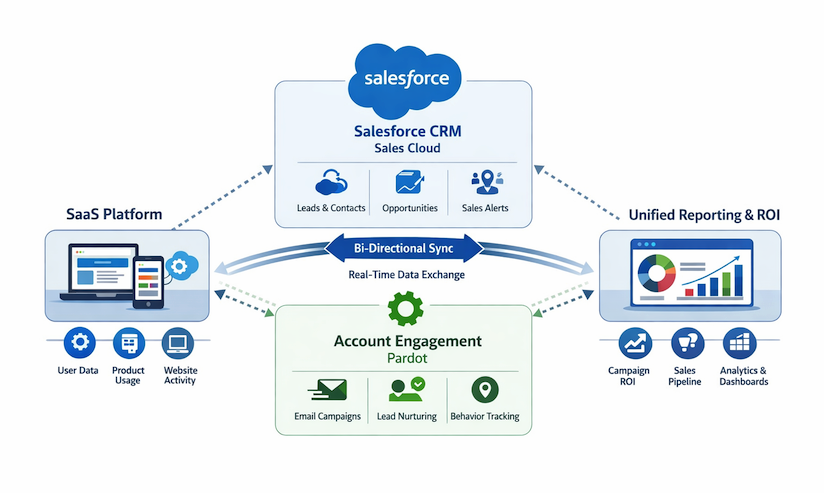
Figure 1: Example architecture integrating a SaaS platform, Salesforce CRM, and Account Engagement (Pardot). This bi-directional integration nurtures prospects in Account Engagement and syncs data in real-time with Salesforce, enabling unified lead management and ROI tracking across systems.
As shown in Figure 1, Account Engagement acts as the marketing automation engine, working in concert with Salesforce CRM (Sales Cloud) and potentially other customer systems (e.g. a SaaS product or website). The integration architecture centers on bi-directional data flow between Pardot and Salesforce. Key aspects of this architecture include:
- Prospect and Lead Synchronization: In Account Engagement, all marketing leads are stored as Prospect records. Pardot uses the prospect’s email address as the unique identifier to sync with Salesforce leads/contacts. Whenever a prospect is assigned to sales or meets certain criteria, the system will attempt to match it to an existing Salesforce Lead or Contact by email. If a matching contact is found in Salesforce, Pardot links the prospect to that contact; if not, it checks for a lead; if none exists, Pardot can automatically create a new Lead in Salesforce. This ensures no potential customer is lost – new prospects flow into Salesforce for sales follow-up, while existing customer interactions are unified under the right record. The synchronization is near-real-time: Pardot and Salesforce sync every ~2 minutes by default, so updates (like a lead status change or a prospect score change) are reflected on both sides almost immediately.
- Shared Data Objects: Account Engagement and Salesforce share key objects to avoid duplication and maintain consistency. Campaigns are a prime example. With Connected Campaigns, Pardot campaigns are directly tied to Salesforce Campaign objects, providing a single campaign hierarchy and reporting source. Marketers can add prospects to Salesforce Campaigns (e.g. via automation rules in Pardot) and then track opportunity revenue back to those campaigns in Salesforce, yielding true closed-loop ROI reporting. Similarly, Pardot can read Salesforce Accounts, Opportunities, and even custom objects (with higher editions) to tailor segmentation and triggers. For instance, if an Opportunity is marked “Closed Won” in Salesforce, Pardot can automatically remove that prospect from a nurture program or add them to a customer upsell campaign. The platform supports up to four custom object syncs, and each must relate to a Lead/Contact in Salesforce’s schema, allowing flexibility to integrate data like product installations or support cases into marketing automation logic.
- User and Permission Integration: Pardot’s user access can be managed through Salesforce profiles/permissions, especially when using the Pardot Lightning App. This means sales reps can view Pardot engagement data (like email opens, website visits) directly on lead/contact records in Salesforce, empowering Sales with marketing insights. Meanwhile, marketers can work within the Salesforce interface to build Pardot emails and forms if desired. The Pardot Lightning App and Salesforce single sign-on create a unified experience – to users, it increasingly feels like one system.
- Automation and Workflow Alignment: The architecture often involves Salesforce workflow rules or triggers complementing Pardot’s automation. In the diagram, when a prospect submits a form in Pardot (e.g. requesting a demo on the website), that form submission is sent to Salesforce (via the connector) and triggers a Salesforce Flow or Assignment Rule to notify a sales rep or create a follow-up task. Lead assignment rules ensure new leads from marketing go to the correct sales owner based on territory or product interest, and Pardot can apply lead scoring and grading that sync to Salesforce fields for sales visibility. This tight interplay guarantees that as marketing-qualified leads (MQLs) are generated, they are promptly routed and acted upon, improving conversion rates (and thus ROI).
- Integration with the Marketing Stack: Beyond Salesforce CRM, Account Engagement offers connectors and APIs to integrate with other marketing tools. For example, Pardot connectors exist for webinar platforms like ReadyTalk and video platforms like Wistia, allowing those prospect activities (webinar attendance, video views) to flow into Pardot and augment a lead’s profile. Pardot’s open API can connect to content management systems, event software, or advertising platforms as well. In a SaaS context, one can integrate a product’s user actions (free trial sign-ups, usage data) into Pardot to trigger tailored marketing journeys. The benefit of such an integrated approach is clear: seamless communication between systems, real-time syncing of customer data, and elimination of manual data transfers. For instance, when a customer updates their preferences in a SaaS app, that data can flow into Pardot to refine email targeting automatically (live profile data). Likewise, if a prospect interacts with a marketing email, that activity is logged in Salesforce for sales to see instantly. This creates a closed-loop system where every touchpoint is connected.
- Reporting and Analytics: From an architecture standpoint, all the data integration culminates in robust reporting capabilities. Salesforce Campaign ROI reports can include Pardot-driven pipeline and revenue, demonstrating marketing’s impact in dollar terms. Pardot’s B2B Marketing Analytics (built on Tableau CRM) further allows technical users to create custom dashboards that blend marketing and sales data – for example, showing how lead score correlates to deal size, or comparing ROI across campaigns and industries. In the Redwood Software case, they built regional dashboards so each team could see how many leads, opportunities, and revenue their Pardot campaigns generated weare4c.com. Real-time, accurate reporting means CMOs and executives get a clear line of sight into marketing ROI without waiting for quarterly reconciliations. In fact, companies have cut down manual reporting effort by 90% by leveraging Marketing Cloud and Pardot’s integrated analytics inspark.com, freeing marketers to focus on strategy.
From a technical perspective, Salesforce Account Engagement’s architecture is designed to ensure marketing efforts directly feed and learn from sales outcomes. Data quality and consistency are maintained by the sync (e.g. deleting a lead in Salesforce can optionally remove the corresponding prospect in Pardot to prevent stale data). Performance and scale are addressed through batching and throttling – for instance, the Pardot-Salesforce connector syncs records in batches of 200 and throttles certain high-volume automations to keep the system running smoothly. This means even as your database grows to millions of prospects, the integration remains reliable and timely.
Finally, the integration architecture is continually evolving. Salesforce is moving more of Pardot “into” the core platform (for example, marketing assets like Email Templates can now be viewed in Salesforce). The end vision is a fully unified platform where marketers and sellers collaborate around a single source of truth for customer data. For now, with the connector and current features, organizations can achieve a near-complete alignment – resulting in faster lead response, richer personalization, and better insight into ROI for each campaign and channel.
Conclusion
Across the technology, healthcare, and manufacturing sectors, Salesforce Account Engagement has demonstrated a consistent ability to improve marketing ROI. The combination of automated lead nurturing, personalized campaigns at scale, and close integration with Salesforce CRM yields tangible benefits: higher lead conversion rates, increased sales pipeline, improved customer retention, and greater efficiency in marketing operations. Tech companies use Account Engagement to streamline global campaigns and attribute revenue to marketing with precision dashboards, proving and improving ROI. Healthcare organizations leverage Pardot to foster patient or client relationships over time, translating to higher lifetime value and marketing spend effectiveness. Manufacturers adopt marketing automation to modernize their demand generation, often seeing double-digit growth in leads and conversions that directly boosts ROI in traditionally sales-driven environments.
Underpinning these successes is Account Engagement’s robust integration architecture. By connecting seamlessly with Salesforce and other systems, Pardot ensures that marketing and sales work from the same playbook – every prospect touch is tracked, scored, and followed up on, and every closed deal is tied back to the campaigns that contributed to it. This closed-loop accountability enables marketing teams to continuously optimize and demonstrate their impact on revenue. It also yields operational savings (through automation and elimination of data silos) that improve the ROI of marketing programs. In short, Account Engagement provides both the tools and the data needed for marketers to not only execute more effective campaigns but also to justify investments with clear ROI metrics.
For executives and technical buyers evaluating Account Engagement, the key takeaways are:
- Proven ROI Uplift: Deploying Pardot leads to measurable improvements in marketing outcomes (e.g. 10–20%+ higher conversion, faster growth) and efficiency (20%+ time savings, quicker lead follow-up), which drive ROI. Many organizations see a payback on their Pardot investment within months, not years, thanks to these gains.
- Industry Adaptability: Whether in high-tech software, healthcare services, or manufacturing, Account Engagement’s core capabilities – email marketing, lead nurturing, scoring, analytics – are adaptable to different buyer journeys. Case studies show it can be successfully tailored to various industry use cases, delivering relevant content and achieving industry-specific KPIs (be it clinician retention or channel partner engagement).
- Technical Robustness and Scalability: The platform’s integration with Salesforce and support for multiple connectors means it can fit into a complex marketing tech stack without missing a beat. Data flows securely and in near real-time, enabling things like instant sales alerts on hot leads or aggregated ROI reports for the entire C-suite. The system is cloud-based and scalable, backed by Salesforce’s infrastructure, which is critical for large enterprises.
- Executive-Level Insights: Account Engagement brings marketing results into the language of business by tying campaigns to revenue. Dashboards and reports can be crafted to show ROI by campaign, by industry segment, by quarter, and more. This empowers CMOs to have data-driven conversations with CEOs/CFOs, shifting marketing from a perceived cost center to a proven revenue generator.
In conclusion, Salesforce Account Engagement (Pardot) is a catalyst for marketing ROI improvement. By automating repetitive tasks, focusing efforts on the most qualified leads, and aligning closely with sales processes, it enables marketing teams to generate more value with their budgets. The success stories from tech, healthcare, and manufacturing illustrate that when implemented with best practices, Account Engagement delivers a powerful one-two punch of increased revenue and reduced waste, the very formula for ROI success. As marketing continues to evolve with data and automation, tools like Account Engagement provide a foundation for companies to not only keep pace but to gain a competitive edge – turning marketing into a growth engine that drives strong returns in any industry.
Sources
- Salesforce, “Marketing ROI (Return on Investment) Defined.” Salesforce.com, 2024. Explains marketing ROI fundamentals and importance. 360degreecloud.com
- SuperAGI Blog, “Avoiding Marketing Automation Pitfalls… Maximizing ROI in the Financial Industry.” June 13, 2025. Cites stats on marketing automation benefits (sales productivity +14.5%, cost -12.2%). superagi.com
- 360degreecloud, “Rejuvenate Email Strategy with Pardot and Marketing Cloud.” Blog post, 2023. Notes Salesforce data on email marketing’s 3,800% average ROI. 360degreecloud.com
- The CRM Firm, “The Cost of Implementing Pardot (Marketing Cloud Account Engagement).” 2022. Discusses Pardot’s ease of use and quick ROI (within months) for B2B firms. thecrmfirm.com
- CEPTES, “Pardot Marketing Automation – The Key to Generate More ROI.” Blog, 2023. Mentions 36% higher retention and 38% win rates with marketing-sales alignment via Pardot. ceptes.com
- CETDIGIT, “How to Get More ROI from Pardot Marketing Automation?” 2017. Shares that nurtured leads yield 20% more sales opportunities, and 84% of marketers saw increased lead gen from automation. cetdigit.com
- 4C (Wipro), “Redwood Software Case Study.” Case study on Pardot for a high-tech firm. Reports 10% increase in lead conversion and integration-enabled ROI reporting for campaigns. weare4c.com
- Girikon, “Salesforce Pardot Success Story for Healthcare Staffing Firm.” Case study, June 2023. Describes use of Engagement Studio for clinician nurturing and improved ROI (retention, re-hires). girikon.com
- Damco Group, “Leading Medical Devices Manufacturer Improved Lead Generation and Conversion with Pardot.” Case study, 2025. Highlights significant improvements in lead conversion, engagement, and brand image after Pardot revamp. damcogroup.com
- PreludeSys, “Top Electronics Manufacturer Increases Lead Conversion by 22% with Pardot.” Success story, 2025. Quantifies 27% more leads, 22% higher conversion, 12% more email conversions, leading to maximized ROI. preludesys.com
- MarCloud Consulting, “Roland DG Case Study – 75% Less Time Managing Forms.” 2024. Shows Pardot form consolidation yielding 99% fewer forms and 75% time saving for a manufacturing firm, improving efficiency and ROI tracking. marcloudconsulting.com
- Salesforce Ben (Lucy Mazalon), “Account Engagement (Pardot) Overview for Salesforce Architects.” Nov 22, 2023. Provides deep insights into Pardot’s data model and Salesforce integration (Connected Campaigns, data sync behaviors). salesforceben.com
- Automation Champion (R. Gupta), “Basics of Pardot and Salesforce Integration.” Updated Aug 31, 2023. Explains how Pardot syncs leads/contacts with Salesforce via email, sync frequency (~2 min), and connector setup. automationchampion.com
- MarCloud (Tom Ryan), “Integrating your SaaS platform with Salesforce and Pardot.” Blog, 2021. Includes a Pardot systems architecture diagram and lists benefits of a fully integrated stack (live data, real-time logging, no manual data transfers). marcloudconsulting.com
- Salesforce News (Inspark), “Nearly 300% ROI with Salesforce Marketing Cloud – Research Reveals.” Press release summary, April 2023. Reports Forrester TEI findings: 299% ROI over 3 years, +60% conversion, +35% average order value, 60% time saved, etc., for Salesforce marketing solutions. inspark.com
Care and Share.