
5 Ways to Align Marketing and Sales with Account Engagement

In today’s complex B2B environment, alignment between marketing and sales isn’t just a nice-to-have – it’s critical for driving revenue growth. Misalignment leads to wasted leads and missed opportunities, especially in industries like B2B technology, healthcare services, and manufacturing where buying cycles are long and involve many stakeholders. In fact, companies with tightly aligned sales and marketing teams have seen up to 32% higher year-over-year revenue growth and 38% higher win rates compared to those without alignment stellaxius.com. Salesforce’s Marketing Cloud Account Engagement (formerly Pardot) provides powerful features to bridge this gap. Below, we outline five actionable ways to align marketing and sales using Account Engagement, with real-life analogies and examples to illustrate each point.
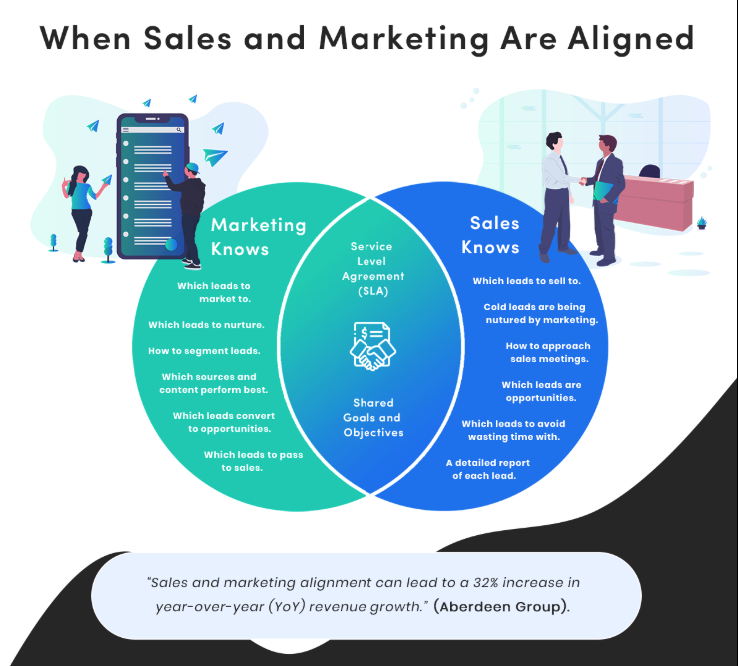
Illustration: Aligning marketing and sales requires unified systems, shared data, and coordinated processes.
1. Define a Common Lead Qualification Model (Scoring & Grading)
The first step to marketing-sales harmony is agreeing on what a “sales-ready” lead looks like. Often, a marketing-qualified lead (MQL) is completely different from a sales-qualified lead (SQL) – marketing might pass every interested contact, while sales expects only high-fit, purchase-ready prospects . It’s like in healthcare: if triage nurses and doctors don’t agree on which patients are high-priority, critical cases might be overlooked. To get on the same page, collaborate on a unified lead qualification model:
- Set shared criteria for quality leads: Marketing and sales should jointly define the ideal customer profile and engagement signals that make a lead qualified. For example, an “A+” lead might be a decision-maker at a target company who has requested a demo. Pardot’s grading system lets you formalize this – assigning letter grades (F to A+) based on how closely a prospect fits your agreed profile. A common definition ensures both teams pursue the same high-value prospects.
- Leverage lead scoring for engagement readiness: Use Pardot’s lead scoring to quantify each prospect’s interest based on their behaviors (email clicks, webinar attendance, page visits, etc.). For instance, you might give +10 points for downloading a whitepaper or +50 for a product demo request. Pardot automatically scores and grades prospects, and only those who meet the agreed threshold are passed to sales, saving reps’ time and focusing them on leads with the most potential. It’s a bit like a manufacturing quality filter – only pieces that meet all specs get forwarded to the next stage. The result: marketing delivers fewer but better leads, and sales trusts that an “MQL” actually merits immediate follow-up.
By aligning on lead qualification, a B2B tech company, for example, can avoid the classic complaint that “marketing’s leads are junk.” Instead, both teams work from a single, data-driven definition of a good lead. Grading and scoring create a transparent standard, so a lead with an A-grade and high score is understood by all to be sales-ready. This clarity reduces friction and boosts conversion rates, as sales engages only when the prospect is primed.
2. Unite Campaigns and Data on One Platform (Connected Campaigns)
One major barrier to alignment is siloed data. Marketing might run campaigns in one system while sales works in another, leading to disjointed views of the customer. Account Engagement solves this by integrating natively with Salesforce CRM and offering Connected Campaigns, which make Salesforce and Pardot campaigns function as one. Think of it as ensuring the entire team is looking at the same “scoreboard” – much like a surgeon and a nurse sharing one patient chart to coordinate care. Here’s how this unification facilitates alignment:
- Single source of truth for campaigns: With Connected Campaigns, all campaigns are created in Salesforce and automatically sync to Pardot, eliminating duplicate or “siloed” campaigns. This campaign alignment reduces errors and confusion about lead sources, since both marketing and sales see the exact same campaign membership and results. For example, if your marketing team in a manufacturing firm runs a trade show campaign, the sales reps can instantly see in Salesforce which leads interacted with that campaign and what they did, instead of juggling spreadsheets.
- Shared engagement history and insights: Account Engagement pushes prospect engagement data (email opens, website visits, form fills, etc.) directly into Salesforce. Sales teams gain full visibility into each prospect’s marketing journey on the account record, letting them work smarter and tailor their approach. A sales rep can see, for instance, that a healthcare prospect attended a webinar and downloaded an e-book before ever making a call. This context means no more cold calls – every sales outreach is informed by prior marketing touchpoints.
- Unified reporting and attribution: Using one connected system also means marketing and sales rely on common metrics and reports. Salesforce reports (and B2B Marketing Analytics dashboards) can attribute pipeline and revenue to marketing efforts without manual reconciliation. Before Connected Campaigns, tracking which campaigns influenced deals was painstaking and error-prone – now marketers can accurately measure ROI and contribution to revenue. This transparency builds trust: sales can clearly see marketing’s impact on deals, and marketing can prove their value in closed business.
For example, a B2B tech company using Connected Campaigns found that engagement history on Salesforce records gave reps a clearer view of the customer journey, leading to more informed conversations. Likewise, a manufacturing firm improved its marketing-sales alignment and even increased conversion rates by integrating Pardot with Salesforce CRM – both teams started working off the same data, identifying which campaigns yielded the best leads and revenue. By uniting around a single source of truth, marketing and sales stop debating data and start collaborating on strategy.
3. Collaborate on Lead Nurturing with Engagement Studio
Even when marketing supplies good leads, not all of them are ready to buy now. That’s where a coordinated nurturing strategy comes in. Marketing Cloud Account Engagement’s Engagement Studio is a visual automation tool that lets marketing build multi-step drip campaigns to educate and warm up prospects over time. When marketing and sales plan these nurture programs together, you ensure no lead slips through the cracks. It’s akin to a relay race baton pass – marketing runs the first laps by nurturing the lead, then smoothly hands off to sales at just the right moment.
How to align on nurturing:
- Design journeys that address sales insights: Sales often knows common objections or information gaps that stall deals. Marketing can use these insights to craft Engagement Studio programs that deliver the right content at the right stage. For example, in a healthcare services context, if sales knows hospital administrators worry about compliance, marketing can include a whitepaper about regulatory compliance in the nurture stream. Pardot makes it easy to build these personalized, logic-based journeys that adjust based on prospect behavior. Both teams should agree on the nurture timeline – e.g., a sequence of educational emails over 4 weeks – and the criteria for a handoff to sales (such as a prospect requesting a demo or reaching a lead score threshold).
- Automate the handoff and follow-up tasks: Account Engagement can automatically transition nurtured leads to sales at the right moment. Define rules or triggers in Engagement Studio (or automation rules) that assign a prospect to a sales rep and notify them as soon as the prospect becomes “sales-ready.” For instance, if a prospect in a B2B tech campaign clicks a pricing link or achieves a score of 100+, Pardot can mark them as marketing-qualified, notify the account owner, and even create a Salesforce task for follow-up. This ensures a swift, consistent handoff – sales can follow up within minutes of a hot prospect’s signal, which dramatically increases the chance of connecting. One Pardot user set a rule that once a lead viewed the product demo video, a rep was alerted immediately; the rep’s quick call led to a win before competitors could pounce.
- Keep nurturing together: Alignment doesn’t end once a lead is passed. If the sales outreach doesn’t convert (e.g. prospect says “call me next quarter”), have a plan to recycle the lead back into a nurture program. Pardot makes this easy: sales can drop the lead into a predefined nurture list in CRM (thanks to marketing’s Engagement Studio program) with one click. The prospect will continue receiving relevant content until they’re ready to talk again. This way, “not now” doesn’t mean “lost forever.” Marketing and sales stay in sync, coordinating to keep the lead warm. A sales rep at a manufacturing company, for example, might add an inactive distributor lead to a “product updates” nurture list right from Salesforce, confident that marketing will continue the conversation until interest is reignited.
By collaborating on nurturing, marketing and sales act as a cohesive unit guiding the buyer’s journey. Marketing automates the education process for early-stage leads, freeing sales to focus only on hot opportunities. Sales, in turn, trusts that marketing is professionally “incubating” the leads and will alert them when a lead is ripe. This joint effort means prospects experience a seamless journey – they get useful information from marketing when they need it, and timely personal engagement from sales when they’re ready. In short, it prevents leads from falling into a black hole. As one Pardot user put it, lead nurturing turns cold leads into “super-sales-ready” leads, so reps never waste time on unqualified prospects.
4. Empower Sales with Real-Time Insights and Tools (Salesforce Engage & Alerts)
For true alignment, your sales team needs more than just periodic lead handoffs – they need ongoing visibility into prospect engagement and the ability to act on it. Salesforce Account Engagement addresses this through features like real-time alerts, engagement reports, and Salesforce Engage (a Pardot add-on that arms sales reps with marketing-approved content and insights). In practice, these tools function like a smart sensor system: when a prospect “pings” with interest, sales is notified instantly, and when sales engages, marketing can monitor that interaction. Empowering sales with these insights creates a two-way street of communication.
Key ways to enable sales with Pardot’s engagement tools:
- Set up real-time prospect alerts: Account Engagement can notify reps the moment a high-value prospect takes an action – for example, visiting the pricing page, filling out a form, or hitting a certain score. These alerts (via email, Salesforce tasks, or even Slack) prompt sales to reach out when interest is peaking. Imagine a healthcare software sales rep gets an alert that a hospital CIO just downloaded a key case study – the rep can call that day and reference the download, a touch that often impresses the prospect. Automated alerts significantly decrease follow-up time and increase success rates by ensuring sales strikes while the iron is hot. No more delays or missed opportunities because a rep didn’t know a lead was active on the site.
- Use Salesforce Engage for one-to-one outreach: Salesforce Engage is a capability that connects Pardot with Sales Cloud, giving reps access to marketing-curated email templates and live engagement data right from Salesforce. With Engage, salespeople can send personalized emails to prospects at scale (using approved templates) and get real-time feedback on engagement – such as opens and clicks. For example, a field sales rep in the manufacturing industry can, from their phone, send a prospect an email with a case study and then see instantly if that prospect opens the email or clicks the link. This insight allows the rep to time a follow-up call perfectly (“I saw you checked out that case study – any questions?”). Engage essentially lets sales piggyback on marketing’s tools: reps access the latest content and see prospect interactions in real time, all within the CRM. This level of sales-marketing synergy was previously hard to achieve – now reps act on marketing data directly, and marketing knows that their content is being used effectively by sales.
- Provide full visibility into the buyer’s journey: Make sure sales reps make use of the Engagement History and insights now available to them. In Account Engagement, every interaction – email responses, web page visits, event attendance – can be logged on the lead or contact record in Salesforce. Sales teams with access to this rich engagement history can tailor their conversations to the prospect’s interests and timing. It’s empowering for a sales exec in B2B tech to open an account in Salesforce and see all the marketing touchpoints (e.g. “Prospect attended Webinar X, downloaded Guide Y, last engaged with email Z yesterday”). That context transforms sales calls into consultative discussions rather than blind pitches. Marketing benefits too: when sales sees value in these insights, they’re more likely to support and request new marketing campaigns (“Our prospects really liked that webinar you ran – let’s do more like that”). In essence, working in one connected platform with shared engagement data allows sales and marketing to “speak the same language” about prospects. Sales can work smarter, and marketing gains a partner who fully utilizes their efforts.
By equipping sales with real-time intel and easy-to-use tools, you create a culture of immediate, informed action. One healthcare services company noted that after enabling Pardot alerts and Engage, their sales team’s response time to lead inquiries went from days to hours, yielding a notable uptick in conversion. When sales feels empowered rather than in the dark, they recognize marketing as an ally. This fourth alignment strategy is all about breaking down the wall between departments in daily operations – with Account Engagement, marketing-generated insight flows straight to sales, and sales activity (like email engagement) flows back for marketing to see. Both teams can then coordinate in real time to guide prospects toward a purchase.
5. Close the Loop with Shared Metrics and Continuous Feedback
Alignment is not a one-off project – it’s an ongoing process of measurement, feedback, and refinement. The most aligned organizations establish a closed-loop reporting and feedback system where marketing and sales jointly track performance and learn from each other. Salesforce Account Engagement, with its connection to Salesforce CRM, makes this possible by providing common reports and dashboards and enabling data to sync both ways. To use an analogy, think of it like a continuous improvement cycle in manufacturing (Kaizen): the team regularly reviews the “product” (lead outcomes), identifies what’s working or not, and makes adjustments for the next cycle.
Here are actionable steps to close the loop between marketing and sales:
- Share metrics and dashboards that matter to both: Develop shared KPIs such as MQL-to-SQL conversion rate, pipeline generated per campaign, and lead response time. With Account Engagement’s Connected Campaigns and CRM integration, you can use Salesforce reports or B2B Marketing Analytics to create full-funnel dashboards that both teams review. For example, a dashboard might show how many leads each campaign generated, how many converted to opportunities, and the revenue won. Pardot’s reporting capabilities allow marketers and reps to work from common definitions and see the same reports, increasing visibility across the entire sales cycle. When both teams are looking at one set of numbers (say, a report on Q1 pipeline by lead source), it focuses discussions on facts, not finger-pointing. C-suite leaders in industries like high-tech appreciate this transparency, as it links marketing activities directly to revenue outcomes.
- Establish a Service Level Agreement (SLA) for follow-up: A practical way to enforce alignment is agreeing on how quickly sales will follow up on marketing leads and how marketing will support that process. For instance, you might set an SLA that 100% of MQLs get a sales follow-up within 1 business day. Define these expectations together and monitor them. Pardot can assist by timestamping lead assignments and even creating tasks for reps. Marketing can then track if SLAs are met (e.g., via a Salesforce report on lead response times). As an example, one company set an SLA that new demo requests must be called within 4 hours; marketing used Pardot to notify the assigned rep immediately and logged follow-up times. This kind of agreement, along with processes in Pardot to enforce it, ensures no qualified lead languishes unanswered. It also signals mutual accountability – marketing delivers quality leads, and sales provides timely attention.
- Feed sales data back into marketing (and vice versa): Alignment deepens when each team’s data informs the other’s strategy. Salesforce-Pardot integration enables bi-directional data syncing – when a salesperson updates a lead’s status or notes in Salesforce (e.g., “Not a fit – too small” or “Deal won – product X sold”), marketing automatically receives that info in Pardot. This closed loop is golden. Marketing can analyze which campaigns yielded the most closed-won deals or examine why certain leads were disqualified. Perhaps you notice many leads from a healthcare webinar were marked “cold” by sales – marketing might then adjust the targeting or content of that campaign. At the same time, if marketing discovers, say, that leads of a certain profile convert better, they can refine the lead grading criteria to reflect that, helping sales get better leads over time. Regular meetings can be instituted to discuss these insights: marketing can ask for feedback on lead quality and share what campaigns are coming up, while sales can highlight which messages resonate or what objections they’re hearing. This ongoing calibration is exactly what fosters trust and continuous improvement.
- Implement a lead recycling mechanism: Not every lead will convert, and that’s okay – as long as there’s a process to recycle and nurture them. Work out a simple method for sales to hand unready leads back to marketing. With Pardot, this could be as easy as sales adding the lead to a “Re-Nurture” list or campaign in Salesforce (made visible to them by marketing). That triggers Pardot to resume automated nurturing so the lead doesn’t go cold. For example, a manufacturing equipment supplier might have sales mark a lead as “Not ready – follow up in 6 months” and add them to the long-term nurture program. Marketing can then continue to send value-adding content (industry trends, product developments) over those months. When the timing is better, that lead can surface again as an active MQL, and sales will already have context from previous interactions. This kind of closed-loop approach ensures no valuable prospects are lost and lessons from every deal (won or lost) inform the next strategy.
In summary, closing the loop is about creating a feedback-rich environment supported by data. Account Engagement’s integration with Salesforce provides the connective tissue for this feedback loop – shared reports, synced lead status, and clear attribution of marketing’s impact on sales. Leadership should champion a culture where both teams celebrate joint wins (e.g., marketing-sourced deals) and dissect losses together to improve. Over time, the constant feedback refines everything from lead criteria to campaign tactics: marketing gets smarter about what truly drives sales, and sales feels heard and supported in shaping marketing strategy. The result is a cycle of continuous improvement that drives revenue growth and efficiency.
Conclusion
Achieving marketing and sales alignment is a journey, but with the right technology and practices, it’s entirely attainable. Salesforce Account Engagement (Pardot) serves as a crucial platform to unite these teams by standardizing lead qualification, sharing data and insights, coordinating nurture efforts, enabling real-time sales actions, and measuring impact on shared dashboards. Whether you’re a CMO of a B2B tech startup, a sales director at a healthcare firm, or a revenue operations lead in manufacturing, these five strategies offer a roadmap to tighter collaboration. Just as a well-synchronized pit crew wins races, a well-aligned marketing and sales team wins more business – they operate as one team with one goal. By implementing lead scoring and grading, connected campaigns, Engagement Studio programs, Salesforce Engage, and closed-loop reporting, you create an engine where marketing generates and educates leads, and sales converts them efficiently, with each informing the other’s success. In the end, alignment isn’t just about getting along; it’s about driving growth. With Account Engagement’s features put into action, marketing and sales can finally “sing from the same hymn sheet,” resulting in more qualified leads, higher win rates, and a unified approach to delighting customers and growing revenue.
Sources: The insights and examples above are supported by real-world best practices and expert guidance, including Salesforce and partner resources on Pardot usage and marketing-sales alignment pardotschool.com stellaxius.com, industry case studies demandblue.com, and thought leadership from consultants who have helped organizations improve collaboration using Marketing Cloud Account Engagement. Each cited source is linked for further reading on how to leverage these tools and techniques to bring your marketing and sales teams into alignment.
Care and Share.