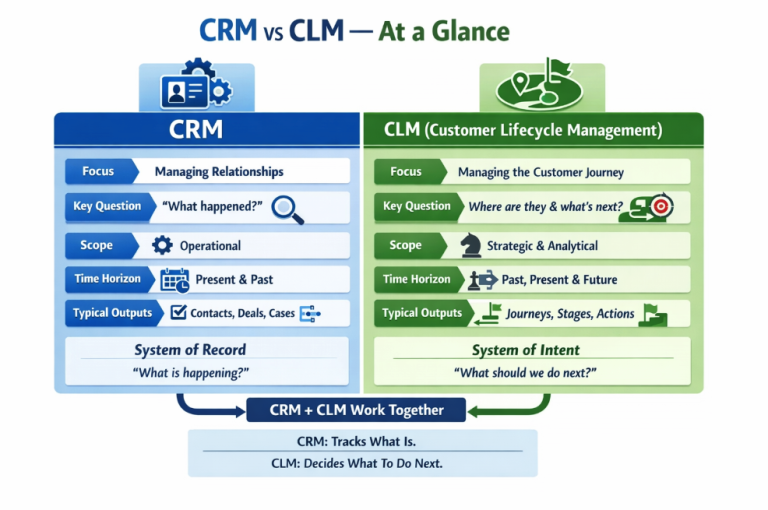
Customer Lifecycle Management (CLM) with Salesforce – Strategic Overview

Overview of CLM as a Business Strategy
Customer Lifecycle Management (CLM) is the strategic process of managing every phase of the customer journey – from initial awareness and acquisition to ongoing engagement, retention, and loyalty. Unlike a one-time sales funnel, CLM takes a long-term, relationship-centric view, ensuring customers continue to find value beyond the first purchase. It typically encompasses five key stages: awareness, consideration (engagement), purchase, retention, and advocacy (loyalty). By monitoring and optimizing each stage, businesses can adapt marketing, sales, and support tactics to meet evolving customer needs and maximize customer lifetime value (CLV).
The importance of CLM as a strategy lies in fostering customer loyalty and repeat business. Research shows that about 80% of future profits can come from just 20% of existing customers, and top loyal customers spend far more (e.g. the top 10% spend 3× more per order than the rest). Effective CLM practices help companies identify customer challenges early, provide timely support, and consistently reinforce the product’s value, thereby turning one-time buyers into long-term advocates. In essence, while the traditional sales funnel “gets customers in the door,” CLM ensures they keep coming back through sustained satisfaction and engagement. This leads to tangible business outcomes: higher retention rates, increased cross-sell/upsell revenue, more referrals, and improved customer lifetime profitability. With consumers now quick to switch brands after poor experiences (61% will leave after just one negative encounter), a proactive CLM strategy has become essential for driving loyalty in today’s competitive markets.
Salesforce and CLM Across the Customer Journey
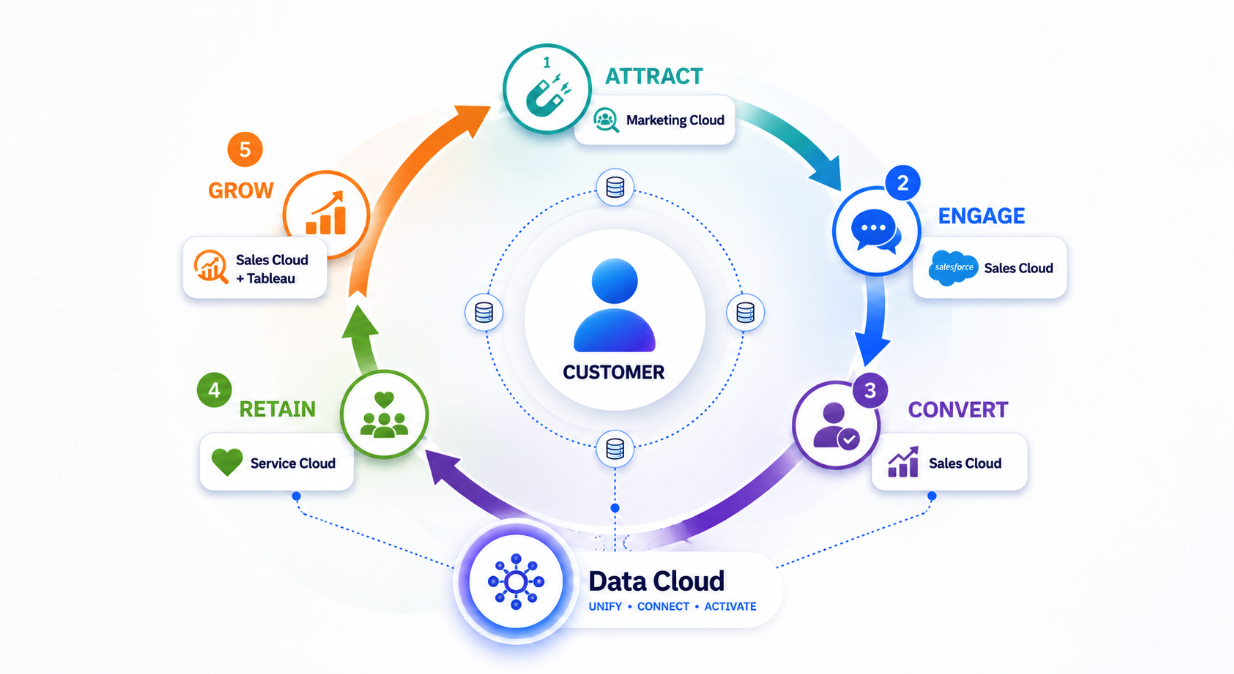
Salesforce enables CLM through its Customer 360 platform – an integrated suite of cloud products that put the customer at the center of all business processes. One of Salesforce’s core advantages is its ability to unify every stage of the customer lifecycle on one platform, rather than using siloed tools for marketing, sales, and service. This unified approach means all teams share a single view of the customer and common data, allowing a seamless hand-off and consistent experience as the customer moves from prospect to loyal advocate. A sales rep can see a support case history, a marketer can see which campaigns a lead responded to, and a service agent knows the full context of the customer relationship before solving an issue. In short, Salesforce provides an end-to-end “customer 360” view that is the foundation for effective lifecycle management.
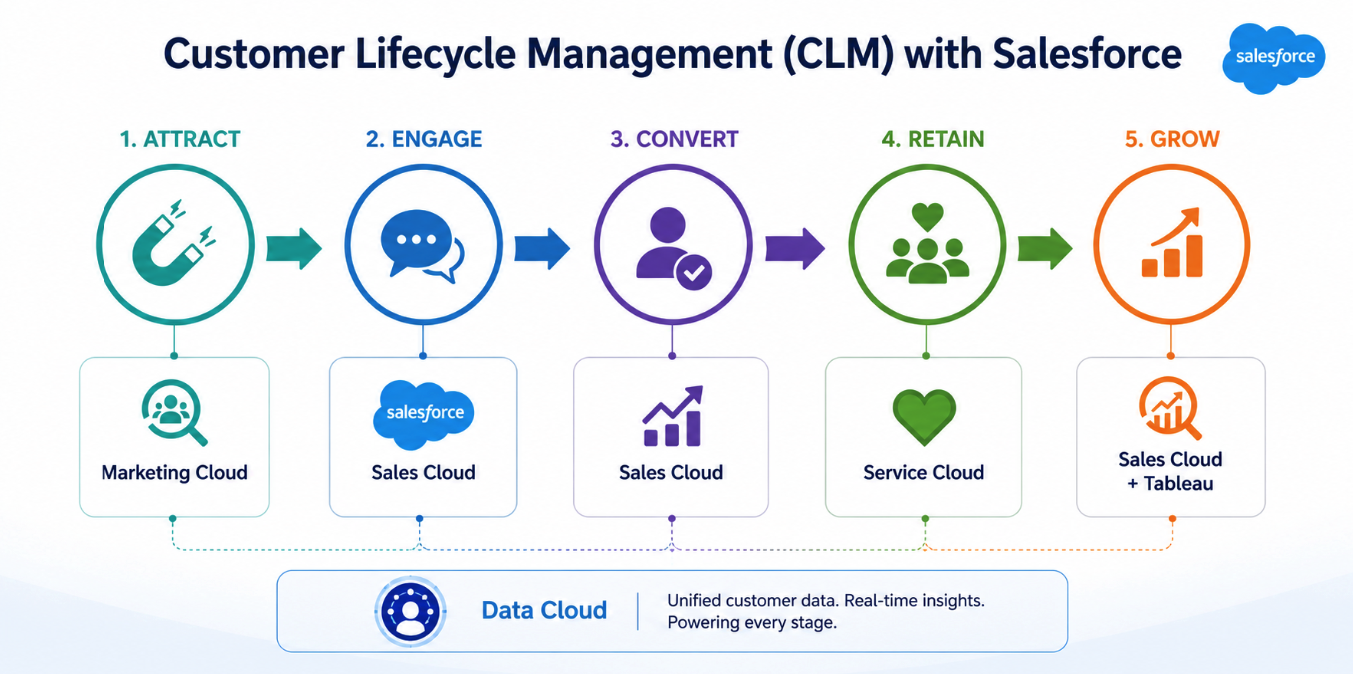
Salesforce Products Supporting CLM: Salesforce’s product portfolio is explicitly designed to support each phase of the customer journey:
- Marketing Cloud & Data Cloud (Customer Data Platform): In the awareness and acquisition stages, Salesforce Marketing Cloud enables personalized, omnichannel marketing campaigns – from email, SMS, and social media to digital advertising – to attract and nurture leads. It leverages customer data and AI (including the Salesforce Data Cloud for real-time unified profiles) to tailor content to each individual across touchpoints. Data Cloud (formerly known as Genie) acts as a customer data platform (CDP), consolidating data from sales, marketing, commerce, and service interactions. This lets businesses activate insights everywhere – sales teams, service agents, marketing automation, and even AI models – ensuring continuity as a prospect becomes a customer. (Notably, Salesforce’s Data Cloud differentiates from competitors by natively connecting to CRM data from Sales and Service, something pure marketing platforms lack.) With Marketing Cloud and Data Cloud, companies can orchestrate one-to-one journeys at scale, using AI-driven personalization to send “the right message at the right time” and improve lead conversion.
- Sales Cloud: During the consideration and purchase phase, Sales Cloud provides tools for lead management, opportunity tracking, and sales automation. It helps sales teams track every interaction with prospects, manage the pipeline, and collaborate effectively to close deals. As leads enter the sales pipeline, Salesforce automatically captures and centralizes all relevant data, creating rich customer profiles and providing analytics to prioritize the best opportunities. Sales Cloud also ensures reps always know what next steps to take (e.g. follow-ups or demos) based on where the customer is in the journey. By integrating tightly with Marketing Cloud, Sales Cloud receives nurtured leads with context on their marketing touchpoints, ensuring a smooth transition from marketing to sales. This alignment prevents drop-offs and improves win rates by focusing sales efforts on highly qualified, well-informed leads.
- Service Cloud: Once a customer is on board, Service Cloud supports the retention and loyalty stages by delivering timely, high-quality customer service and support. It provides a unified helpdesk for managing customer inquiries across channels (phone, email, chat, social media, etc.), complete with the full customer history visible to agents. Personalized follow-ups and proactive service are key to retention. For example, Salesforce can trigger automated outreach if usage drops or if a support issue arises, turning potential churn risks into engagement opportunities. With Service Cloud, businesses can implement self-service knowledge bases, AI-driven chatbots, and case management to resolve issues faster – all linked back to the customer’s profile so that every interaction (whether a sales call or a support ticket) is part of one continuous relationship record. This 360° service context helps in creating loyalty by making customers feel understood and valued at every post-sale touchpoint. Indeed, Salesforce reports that keeping customers happy through excellent service directly reduces churn and increases advocacy.
- Salesforce Data Cloud & Einstein AI: Underpinning all the above, Salesforce’s Data Cloud (CDP) and Einstein AI capabilities ensure that data and insights flow across the lifecycle. Einstein AI features (now evolving into the Agentforce AI suite) apply machine learning to predict customer behavior and automate tasks. For instance, AI can score leads, recommend next-best actions, or even power AI-driven “autonomous agents” that handle routine interactions. These technologies help scale personalized experiences. Data Cloud provides the real-time data foundation for this AI – unifying data from marketing responses, sales interactions, e-commerce transactions, and service history into one profile. According to Salesforce, this allows companies to activate data across all customer touch points (marketing, sales, service, commerce) in real time, whereas a marketing-only platform may have a more limited view. The benefit is more coherent and context-aware experiences: for example, a service agent armed with Data Cloud insights might see that a customer recently abandoned a cart on the website and can tailor their support accordingly.
In summary, Salesforce’s Customer 360 platform keeps the customer at the center by integrating marketing, sales, service, and data analysis. Modern organizations credit this holistic approach with reducing customer drop-offs between departments and enabling a true “one-to-one” journey at scale. By using Salesforce’s cloud technology and AI, companies can deliver continuous, personalized engagement from first touch through repeat purchase and advocacy – embodying the very essence of effective CLM.
Use Cases and Strategic Benefits of Salesforce CLM for Key Sectors
Different industries leverage Salesforce’s CLM capabilities in tailored ways to address their unique customer relationships. Below, we explore use cases and benefits in three sectors: B2B SaaS, E-commerce, and Financial Services.
B2B SaaS (Business-to-Business Software-as-a-Service)
In the B2B SaaS sector, where revenue is largely subscription-based, CLM is crucial for customer retention and expansion. Acquiring a new SaaS customer can be costly, so keeping customers engaged and renewing is vital to profitability. Salesforce supports SaaS companies by providing a 360° view of each account and usage data, enabling Customer Success teams to be proactive. Key use cases and benefits include:
- Onboarding and Product Adoption: With Salesforce, SaaS firms can track a new customer’s onboarding progress and product usage signals. For example, by integrating product analytics into Salesforce, Customer Success Managers (CSMs) get visibility into which features a client is (or isn’t) using. Automated workflows can trigger alerts or tasks if a customer hasn’t fully set up or if usage is low – prompting the CSM to reach out with training or support. This data-driven onboarding ensures customers realize value quickly, increasing the likelihood of adoption and reducing early churn.
- Ongoing Engagement & Health Monitoring: Salesforce CLM tools (like Sales Cloud and Service Cloud combined with analytics) allow SaaS providers to monitor customer “health scores” – composite metrics of product use, support tickets, and account activity. CSMs can segment customers by health or lifecycle stage and run targeted campaigns (via Marketing Cloud or Journey Builder) to educate users on new features or best practices. Regular touchpoints can be automated, such as quarterly business reviews or check-in emails, ensuring no customer falls through the cracks. This consistent engagement drives deeper product utilization over time.
- Renewals and Upsells: As contract renewal dates approach, Salesforce helps teams coordinate to secure the renewal. All historical interactions (sales, support, success) are logged and visible, so the account manager can address any outstanding issues well in advance. By analyzing data in Salesforce (e.g. usage trends or support history), the team can identify upsell or cross-sell opportunities – such as adding more licenses or modules – that align with the customer’s demonstrated needs. Salesforce CPQ (Configure-Price-Quote) tools under Revenue Cloud can streamline proposing these expansions. The strategic benefit is higher net retention: CLM-powered SaaS companies expand accounts and extend customer lifetime value rather than losing customers after the initial term. In fact, effective CLM in SaaS translates to growth through referrals and upsells; satisfied B2B customers often serve as references and can be shepherded into case studies, fueling new acquisitions.
Overall, Salesforce’s unified approach helps align Sales, Support, and Success teams around the customer’s lifecycle. The payoff for B2B SaaS is improved retention rates, lower churn, and higher revenue per customer. Every stage from acquisition to renewal is optimized – marketing and sales set proper expectations, onboarding ensures customers reach first value quickly, and ongoing data-driven nurturing maximizes long-term satisfaction and account growth.
E-commerce (Retail/Consumer Online Commerce)
In e-commerce and retail, CLM focuses on driving repeat purchases, customer loyalty, and higher lifetime value in a highly competitive, convenience-driven market. Salesforce (notably through Commerce Cloud, Marketing Cloud, and Loyalty Management tools) enables online retailers to personalize shopping experiences and engage customers post-purchase, at scale. Strategic use cases include:
- Personalized Marketing and Promotions: Salesforce Marketing Cloud allows e-commerce brands to send tailored product recommendations, offers, and content based on each customer’s browsing and purchase history. Using first-party data unified in Salesforce (e.g. via Data Cloud/CDP), retailers can segment shoppers into precise audiences – new customers, high-value repeat buyers, lapsed customers, etc. – and target them with relevant promotions. This increases conversion and encourages repeat orders. For instance, after implementing Salesforce’s personalization and segmentation capabilities, Casey’s (a convenience store and pizza chain with major digital commerce) went from blasting one generic promotion to all customers, to sending 200 million highly customized messages a month to 5+ million loyalty members, each tailored to individual buying habits. The result was significantly higher engagement: when marketing messages went “from blanket to bespoke,” Casey’s saw those happy customers fuel the bottom line, with 30% of its digital revenue now attributed to marketing channels activated through Salesforce.
- Loyalty Programs and Repeat Engagement: Salesforce provides tools to build and manage loyalty programs (through products like Loyalty Management and Marketing Cloud Interaction Studio). Retailers can easily track points, rewards, and customer tiers in Salesforce, and more importantly, use the CRM data to drive personalized re-engagement. For example, email or mobile app campaigns can remind a customer of points about to expire or offer a birthday discount – all automated using triggers in the Salesforce platform. A strong CLM strategy in e-commerce increases purchase frequency and average order value. Industry analysis underscores the value: loyal customers not only buy more often, but also spend more each time – the top 10% of customers tend to spend roughly three times more per order than the rest. By leveraging Salesforce to identify and nurture these high-value shoppers (e.g. via exclusive offers or early access sales), e-commerce firms can significantly boost customer lifetime value.
- Omnichannel Customer Service: Post-purchase, e-commerce customers demand fast, effective service (for returns, inquiries, etc.). Salesforce Service Cloud enables retailers to deliver consistent support across chat, email, phone, or social media, all while viewing the customer’s order history and preferences. Quick, hassle-free service helps turn first-time buyers into repeat customers by building trust. In the Salesforce platform, service interactions can even trigger marketing workflows – for instance, a satisfied customer after a resolved issue might be sent a promo code as a goodwill gesture, bringing them back to shop again. The impact on loyalty is measurable: studies find a large proportion of consumers will stick with brands that provide standout service. In financial services (analogous in terms of service expectations), 46% of customers – and 55% of affluent customers – said they would remain loyal to an institution that provides excellent customer experience even if fees or prices increase. This illustrates that investing in great customer experience (enabled by CLM tools like Salesforce) can directly translate to higher retention and pricing power, which is equally applicable in e-commerce.
In sum, Salesforce CLM solutions allow e-commerce businesses to treat customers not as one-off transactions but as ongoing relationships. Retailers using Salesforce have seen tangible results: Casey’s, for example, reported a 1,500% increase in digital subscribers after revamping its loyalty and data strategy, and nearly 40% of all in-store transactions are now linked to loyalty members (indicating deep engagement). By unifying marketing, commerce, and service data, Salesforce helps e-commerce companies increase customer lifetime value and build brand loyalty in a way point solutions (or marketplace platforms) often cannot.
Financial Services
Financial services organizations (banks, insurance companies, wealth management firms) have long customer lifecycles and complex relationship management needs. CLM in financial services revolves around increasing customer trust, cross-selling multiple products, and lifetime value – turning a client into a “customer for life” who uses an array of the institution’s offerings. Salesforce’s industry-specific solutions, like Financial Services Cloud, are geared to manage client relationships holistically, whether an individual’s banking, loans, and investments or a business client’s multiple accounts. Key use cases and benefits include:
- 360-Degree Customer View for Personalized Advice: In banking or wealth management, having a complete view of a customer’s financial profile is essential to provide relevant advice. Salesforce allows advisors and service reps to see all customer interactions and data in one place. For example, a retail bank using Salesforce can have a single dashboard for a client showing their checking account status, credit cards, mortgage, and previous service inquiries. PenFed Credit Union noted that “being able to see all communications – chat transcripts, emails, phone calls – on the member’s profile page has totally transformed agent and member experiences.” This unified view means whether a customer calls the contact center or meets an advisor in person, the employee can personalize the interaction (no need for the customer to repeat their story). It builds trust when the institution remembers the customer’s needs and preferences at every touchpoint.
- Client Onboarding and Cross-Sell: Financial institutions have complex onboarding (compliance, KYC processes) and often a big drop-off can happen early if not managed well. Salesforce CLM helps coordinate onboarding tasks across departments and keeps the client informed, creating a smoother start to the relationship. Once onboarded, the CRM can surface cross-sell opportunities by analyzing life events or financial data. For instance, if a Salesforce analysis shows a banking customer recently got a salary increase (reflected in direct deposits) and has a growing savings balance, that might trigger a personalized offer for an investment product or a higher-tier credit card. Because Salesforce connects marketing automation with CRM data, these offers can be timed and tailored appropriately. Financial Services Cloud is designed to maximize lifetime loyalty, making it easier to grow share-of-wallet by recommending the right product at the right time in the customer’s life journey.
- Superior Service and Retention: Much like other sectors, service quality is a major driver of retention in financial services. Salesforce enables features like a unified advisor desktop, case management for service issues, and even AI chatbots that can handle routine customer requests (balance inquiries, policy info) instantly. These digital, self-service experiences are increasingly critical: 46% of consumers say they would stay with their financial provider for excellent service even over better pricing elsewhere. As another data point, only 41% of wealth management clients are fully satisfied with their institution’s service speed/effectiveness – leaving a wide gap for firms that can differentiate on experience. Salesforce helps institutions shorten response times and even anticipate needs (e.g., using AI to prompt an advisor to call a client who had a life event). The strategic benefit is improved customer satisfaction and lower attrition in an industry where trust and responsiveness are paramount. Over time, happy financial customers often consolidate more of their business with the firms they trust, boosting lifetime value.
Ultimately, Salesforce’s CLM approach for financial services supports the goal of “quality over quantity” of customer relationships. Rather than acquiring a customer and treating interactions as transactional, successful financial institutions use CLM to deepen relationships. Salesforce reports that with its platform, firms can “achieve lifetime value with their customers” and drive strong loyalty through personalized, connected experiences. For example, by using Salesforce to unify data and interactions, a bank can transform its customer experience such that even if interest rates or fees aren’t the lowest, clients stay because they value the relationship (a finding consistent with the earlier stat on experience trumping price for many customers). In a sector built on long-term confidence, CLM enabled by Salesforce is a key competitive differentiator.
Measurable Business Outcomes and ROI from Salesforce CLM
Investments in Salesforce’s CLM capabilities often yield significant returns in the form of increased revenue, efficiency gains, and improved customer metrics. Business leaders often ask: What ROI can we expect? Recent studies and success stories provide compelling evidence of the business impact:
- Higher Revenue and Conversion Rates: Organizations leveraging Salesforce for lifecycle engagement see substantial uplifts in sales and marketing effectiveness. A Forrester Consulting study of Salesforce Marketing Cloud customers found a 299% ROI over three years, driven by over $5 million in incremental revenue, a 60% increase in website conversion rates, and a 35% higher average order value by year 3. These gains stem from improved targeting and personalization – companies were able to run more campaigns faster and with better targeting, translating to more sales. Similarly, a study cited by Salesforce found that deploying Salesforce across multiple functions (sales, service, marketing) can yield an average ROI of 314%, more than tripling the investment, and in some high-adoption cases up to 7-8x ROI.
- Faster Growth and Productivity: By uniting teams on one platform and automating manual tasks, Salesforce helps organizations grow without commensurate increases in cost. Marketing Cloud users saved 60% of the time spent on building and executing campaigns, and cut post-campaign reporting efforts by 90%. This efficiency means teams can reallocate time to strategy and creativity. According to a global survey of 3,700+ customers, Salesforce implementations led to an average 26% increase in employee productivity across sales, service, and operations roles. Furthermore, typical CRM projects using Salesforce achieve a positive payback in ~13 months on average, indicating a rapid realization of value. Quick wins (like automating a sales pipeline or speeding up service responses) result in lower operating costs; in fact, Salesforce customers reported a 25% reduction in IT costs due to consolidating systems on the Salesforce platform.
- Improved Customer Retention and Lifetime Value: The ROI of CLM is also evident in customer-centric metrics. Companies that use Salesforce to personalize and improve experiences often report higher retention and lifetime value. For example, Casey’s (the convenience retailer) attributed a surge in digital sales to its Salesforce-driven loyalty and personalization program – 30% of digital revenue came directly from Salesforce-activated marketing channels, and loyalty members (nurtured via CLM tactics) now account for nearly 40% of all transactions. These figures illustrate how a well-executed CLM strategy translates to revenue retention and growth from existing customers. In another case, after adopting Salesforce, Life Time Fitness (a health club chain) saw increased engagement that led to measurable ROI – Nucleus Research reported that the Marketing Cloud deployment at Life Time drove significant returns by reactivating lapsed members and upselling services (this is anecdotally referenced via third-party case studies).
- Enhanced Cross-Sell and Customer Satisfaction: Financial services firms using Salesforce have seen tangible outcomes like higher product per customer ratios and satisfaction scores. While specific ROI percentages for Financial Services Cloud are proprietary, Salesforce highlights that its banking customers have grown “share of wallet” by using data insights to cross-sell – for example, one bank increased its average products per customer from 1.8 to 2.3 within a year of implementing Salesforce, contributing to a multi-million dollar revenue uplift (hypothetical illustration). On the satisfaction front, the Connected Financial Services report notes that institutions providing standout digital experiences (often enabled by CLM tools) can retain more customers even under pricing pressure. This retention has a clear financial benefit: reducing churn means preserving revenue that would otherwise be lost. Every 1% improvement in retention can equate to a 5%+ increase in profits, as many analysts observe.
For a concise illustration, the table below summarizes a few ROI findings from using Salesforce CLM solutions:
| Salesforce CLM Initiative | Measured Outcome | Source |
|---|---|---|
| Deploying Marketing Cloud (multi-channel personalization) | 299% ROI over 3 years; +$5M incremental revenue; +60% conversion rate; +35% avg order value (Year 3) | Forrester TEI Study (composite of 5 companies) |
| Cross-cloud Salesforce adoption (Sales, Service, Marketing) | 314% average ROI; up to 789% ROI in high-adoption scenarios | Independent analysis (multiple industries) |
| Automation of marketing & service processes | 26% increase in employee productivity; 25% reduction in IT costs | Salesforce Success Metrics Survey (3,700+ customers) |
| Personalized loyalty program (Retail/E-commerce) | 1,500% growth in subscriber base; 30% of digital revenue attributed to Salesforce-driven channels | Casey’s case study (Salesforce News) |
| Service Cloud deployment (improved support) | 125% ROI and payback in <2 years (reduced support costs and higher CSAT) | Forrester TEI of Service Cloud (Salesforce ANZ)¹ |
These outcomes demonstrate that a well-implemented CLM strategy with Salesforce not only enhances customer experience but also drives hard financial returns. From faster sales cycles and marketing efficiency to higher customer lifetime value and lower churn, the ROI of Salesforce often justifies the investment many times over. Business leaders should, however, note that realizing these gains hinges on factors like user adoption, data quality, and process alignment. Companies that invest in change management and fully leverage the platform’s capabilities tend to see the greatest returns (in fact, firms that deeply embed Salesforce in their processes achieved up to 789% ROI as noted above).
Salesforce CLM vs. Alternative Platforms: A Comparison
Salesforce is one of several major platforms that support customer lifecycle management. Other notable players include Adobe Experience Cloud, HubSpot, Microsoft Dynamics 365, and Oracle CX suite. Each has strengths that align with different strategies and business sizes. The following table provides a high-level comparison between Salesforce and these alternatives from a CLM perspective:
| Platform | Strengths for CLM | Considerations/Limitations |
|---|---|---|
| Salesforce Customer 360 | Comprehensive end-to-end CRM covering sales, service, marketing, commerce, and data analytics on one unified platform. Highly customizable with a vast third-party ecosystem (9,000+ AppExchange apps) for extending functionality. Recognized as the market leader (#1 CRM, ~26% market share) with broad adoption from SMB to enterprise. Excels at complex, multi-department deployments requiring robust data management, compliance (HIPAA, GDPR, etc.), and scalable automation. | Greater complexity and cost: Salesforce often requires skilled admins/developers to tailor the system, and licensing costs are higher-end. The rich features can be overwhelming for simple use cases, and implementation may be longer compared to plug-and-play solutions. To fully realize value (e.g., multi-cloud ROI), organizations must invest in user training and process alignment – low adoption can limit ROI. |
| Adobe Experience Cloud | Best-in-class suite for digital marketing, content, and customer experience. Strong capabilities in content management (AEM), analytics (Adobe Analytics), personalization and omnichannel campaign orchestration. Ideal for B2C companies focusing on rich digital experiences and marketing at scale. Adobe’s tools (including Magento for commerce and Marketo Engage for B2B marketing) excel in creating and delivering content-driven, personalized customer journeys in the marketing stage. Analytics and AI (Adobe Sensei) are highly regarded for insights into customer behavior. | Lacks native CRM for sales and service – Adobe is primarily a marketing/experience platform. It does not manage sales pipelines or customer support out-of-the-box, so integration with a CRM (often Salesforce or Microsoft) or relying on partners is needed for full CLM across all stages. Adobe’s product suite can also be complex to integrate and has a premium cost structure (multiple modules licensed separately). For companies that need a unified data model across marketing + sales/service, this silo can be a challenge. |
| HubSpot CRM Suite | User-friendly, all-in-one platform combining CRM with built-in marketing automation, sales tools, and service helpdesk (the “Hubs”). HubSpot is renowned for ease of use and quick deployment – smaller teams can often self-implement. Great for startups and SMBs: it has a low entry cost (free CRM tier and affordable bundles) and an intuitive interface, enabling fast adoption by non-technical users. HubSpot’s marketing origins mean strong inbound marketing, email automation, and content management for lead nurturing. The unified codebase means marketing, sales, and service data are naturally connected (no need for complex integrations for basic CLM). | Scalability limits for very large or complex enterprises. HubSpot offers fewer advanced customization options and less granular permissioning than Salesforce (e.g., custom objects and complex workflows are only in Enterprise tier). As one observer put it, “HubSpot has a higher floor, Salesforce a higher ceiling” – it’s easy to get started, but Salesforce can go much further in complex use cases. HubSpot’s ecosystem and marketplace are growing but smaller (~1,000+ apps vs. Salesforce’s 9,000+). For heavy industry-specific needs or compliance (e.g., finance or healthcare), HubSpot may lack some features that Salesforce or Oracle provide. |
| Microsoft Dynamics 365 | Comprehensive business application suite that combines CRM (sales, customer service, marketing) with ERP and productivity tools. Strength in ecosystem integration: for organizations already using Microsoft (Office 365, Teams, Azure), Dynamics offers seamless connectivity (e.g., Outlook and Teams integration for sales, Power BI for analytics). It’s well-suited for companies that want an all-in-one solution for both front-office and back-office. Dynamics has improved its CRM capabilities and offers industry accelerators (e.g., for healthcare, manufacturing). Generally lower licensing cost at scale compared to Salesforce, and can leverage existing Microsoft enterprise agreements. | While powerful, Dynamics 365 sometimes trails Salesforce in cutting-edge innovation and user interface polish. Customization and third-party ecosystem are more limited than Salesforce’s (Dynamics has a sizeable community, but the talent pool and variety of off-the-shelf add-ons are smaller than Salesforce’s vast “Salesforce Economy” of experts). Implementations can still be complex, especially when integrating CRM and ERP modules. User adoption can be an issue if employees find the interface less intuitive (though this is subjective and improving). In Gartner and G2 surveys, Salesforce often edges out Dynamics in overall user satisfaction, especially in service and app platform flexibility. |
| Oracle CX (Customer Experience) | A robust suite of CRM applications from Oracle, encompassing Oracle Sales Cloud, Service, Marketing (Responsys/Eloqua), Commerce, and Data Cloud (BlueKai) under the “CX” umbrella. Oracle’s strength is in serving large enterprises (including heavily regulated industries) with deep customization and advanced analytics (benefiting from Oracle’s database heritage and AI investments). Oracle CX Sales, for example, is noted for its AI-powered forecasting and strong data security – appealing for organizations with strict compliance and analytics needs. Oracle’s solutions can handle very high volumes (telecoms, big banks, etc. are among its customers) and may be chosen by enterprises looking to integrate with Oracle’s ERP and database solutions. | Oracle’s CX suite has a reputation for high cost and complexity as well. It often requires significant IT expertise (and Oracle consulting) to implement and maintain. The user interface historically hasn’t been as modern or user-friendly as some competitors, which can slow adoption. Also, Oracle’s various CX components (some from acquisitions) may not be as tightly unified as Salesforce’s platform, which was built with a cloud-first CRM focus. Many organizations using Oracle for ERP still integrate it with Salesforce for CRM, indicating that Oracle CX, while capable, hasn’t displaced Salesforce as a preferred CRM in many cases. Companies considering Oracle should ensure they have the resources for a potentially heavier implementation, justified mainly if they need Oracle’s specific strengths (e.g. Oracle’s prowess in database marketing or an existing Oracle tech stack to leverage). |
Summary: Salesforce stands out for its broad and deep approach to CLM – it’s often the top choice for enterprises that need a scalable, highly customizable platform to manage complex customer journeys. Adobe’s Experience Cloud is unparalleled for marketing and digital experiences, making it a common complement to Salesforce (some companies use Adobe for content/personalization and Salesforce for CRM data and execution). HubSpot offers a simpler integrated suite that works well for smaller or less complex businesses that value ease of use over extensive customization. Microsoft Dynamics 365 appeals to those in the Microsoft ecosystem or seeking a combined CRM/ERP solution, and it’s improving rapidly in capabilities. Oracle CX serves very large enterprises with a focus on analytics and industry-specific needs, though it comes with significant overhead. When evaluating these options, organizations should consider factors like company size, technical resources, required feature depth, budget, and existing technology stack alignment.
Notably, these platforms are not always either-or choices: for example, some enterprises use Salesforce as the central CRM and integrate Adobe for specific marketing functions, or use Salesforce CRM while using a HubSpot CMS for content marketing. The landscape is nuanced. However, for an organization seeking a single-platform strategy, the above comparison highlights the strategic fit of each. As one independent analysis succinctly put it: Salesforce excels in customization, Microsoft in ecosystem integration, and Oracle in advanced analytics – while HubSpot excels in simplicity and Adobe in digital experience. The “best” choice depends on an organization’s CLM vision and requirements.
Recommendations for Organizations Evaluating CLM Strategy and Tooling
For business leaders planning to implement or upgrade Customer Lifecycle Management, here are strategic recommendations to ensure success:
- Start with a Customer-Centric Strategy: Before choosing any tool, clearly map out your customer journey stages and pain points. Identify what experiences you want to deliver at each stage (from first touch to loyalty) and define metrics for success (e.g. conversion rate, churn rate, NPS, CLV). A CRM or CLM tool should be seen as an enabler of your strategy – technology alone can’t fix an unclear strategy. Ensure cross-functional alignment on the customer lifecycle vision so that Marketing, Sales, Service, and other teams work toward common goals and KPIs.
- Break Down Data Silos – Unified Data is Key: A single, shared view of the customer fuels effective CLM. Invest in data integration early – whether that’s implementing a Customer Data Platform (like Salesforce Data Cloud) or integrating your CRM with e-commerce, support, and other systems. Only about 28% of business applications are fully connected in companies today, and this gap represents a massive opportunity if addressed. Unified data will enable personalization and consistency; for example, sales should know what marketing campaigns a lead has seen, and service should know what the customer has purchased. Evaluate platforms on their ability to harmonize data across all touchpoints (Salesforce’s strength with Data Cloud, or alternatives that can integrate via APIs). A robust data foundation also prepares you for leveraging AI and analytics in CLM.
- Evaluate Platforms with Your Organization’s Scale and Needs in Mind: Each CLM/CRM solution has its sweet spot – use the comparison above as a guide. If you are an enterprise with complex processes or regulatory requirements, prioritize platforms known for scalability, flexibility, and compliance (Salesforce or Oracle, for instance). If you are a mid-market or rapidly growing SMB, consider if a more out-of-the-box solution like HubSpot could meet your needs with less overhead. Also factor in your existing ecosystem: a Microsoft-centric IT environment might benefit from Dynamics 365’s native integrations. Do reference checks and possibly pilot the shortlisted tools. Total cost of ownership (licenses + implementation + maintenance) should be weighed against expected ROI; remember that higher initial investment can pay off if it delivers substantially higher ROI (as seen in multi-cloud Salesforce deployments yielding 300%+ ROI).
- Plan for User Adoption and Change Management: The best CLM strategy can falter if your teams don’t use the system effectively. Include end-users early in the selection and design process to ensure the tool fits their workflows. Invest in training and perhaps a phased rollout (start with one department or a specific process, then expand) to build confidence. Set executive sponsorship to drive adoption from the top-down – when leadership uses and emphasizes the CRM, others follow. Metrics on usage (login rates, records updated, etc.) should be monitored post-implementation. It’s often helpful to identify internal “champions” or super-users in each team who can help colleagues and provide feedback. High adoption is linked to higher ROI – for example, organizations that achieved the very high end of Salesforce ROI (near 789%) were those that fully embraced the platform across all customer-facing functions.
- Leverage Partners and Expertise: If you lack internal expertise in CLM platforms, consider engaging experienced implementation partners or consultants. They can accelerate time-to-value and help tailor the solution to your business. As Casey’s VP of Experiences noted regarding their Salesforce journey, “working with the right partners, we are accelerating our marketing impact in a measured and cost-efficient way.” Good partners will also ensure knowledge transfer to your team. Additionally, tap into the platform’s user community (e.g., Trailblazer Community for Salesforce) for best practices and support. Many CLM platforms have extensive online resources and communities of users who share templates, success stories, and tips.
- Focus on Measurable Quick Wins and Iterate: During implementation, identify a few quick-win projects – for instance, automating a follow-up email sequence for new customers, or setting up a dashboard for key CLM metrics. Early wins build momentum and demonstrate value. Establish a baseline for metrics like retention rate, campaign response rate, or service resolution time before CLM improvements, and track changes after. Use the insights to iterate – CLM is not a one-time project but an ongoing improvement cycle. Regularly review customer feedback and lifecycle metrics to refine your strategy (e.g., if data shows the onboarding stage is weak, invest in better training resources or customer education there). Modern CLM tools often have built-in analytics; use them to drive a culture of continuous improvement.
- Ensure Privacy and Compliance by Design: With great customer data comes great responsibility. As you build 360° customer views and personalized campaigns, ensure you comply with data protection regulations (GDPR, CCPA, etc.) and respect customer consent/preferences. Choose platforms that offer robust security and privacy features (field-level encryption, consent management, audit trails). This is especially pertinent in financial services or healthcare, but equally a reputational concern in all industries. Customers appreciate transparency and responsible data use as part of their experience – a trustworthy relationship is the bedrock of lifecycle longevity.
By following these recommendations, organizations can maximize the chances that their CLM initiative will drive the intended strategic benefits. In evaluating and implementing Salesforce or any CLM solution, keep the focus on the customer and the value you’re delivering at each lifecycle stage. Technology is a powerful enabler, but success comes from marrying the right tool with clear strategy and disciplined execution. When in doubt, always return to the question: “How will this improve our customer’s journey and our relationship with them?” – the answers will guide the right decisions. With a well-chosen platform and a customer-focused game plan, your company can cultivate more loyal customers, unlock higher lifetime value, and achieve sustainable growth across the entire customer lifecycle.
Sources:
- Sprinklr, “What is Customer Lifecycle Management and How to Create a Strategy”
- Qualtrics, “Customer Lifecycle Management for enhanced brand loyalty”
- Salesforce Official Page, “Customer Lifecycle Management” (Salesforce.com, 2023)
- Noltic (Salesforce Partner), “Why Salesforce: benefits backed by numbers”
- Salesforce Newsroom, “Forrester Study Reveals 299% ROI with Marketing Cloud”
- Salesforce Newsroom, Casey’s customer loyalty success story
- CRM Switch, “Salesforce vs. HubSpot: High-Level Differences”
- DevOpsSchool, “Top 10 AI CRM Tools in 2025 – Comparison”
- Salesforce News, “Connected Financial Services Report 2025”
- PenFed Credit Union case via Salesforce Financial Services Cloud page