Salesforce Marketing Cloud vs HubSpot Marketing Hub

Selecting the right marketing automation platform has become a defining strategic decision for organizations looking to scale revenue, streamline operations, and deliver personalized customer experiences.
Two of the most frequently compared solutions – HubSpot Marketing Hub and Salesforce Marketing Cloud (SFMC) – represent fundamentally different philosophies in how modern marketing teams should operate.
HubSpot is built around accessibility, unified CRM, and inbound marketing, offering a wide on-ramp for startups, SMBs, and mid-market companies.
Salesforce Marketing Cloud, on the other hand, is engineered for enterprise-grade orchestration, deep integrations, and high-volume omnichannel engagement.
This analysis provides a comprehensive, data-informed comparison across pricing, scalability, automation capabilities, multichannel marketing, CRM integration, analytics, AI features, industry suitability, and long-term total cost of ownership. Whether your organization is evaluating a first-time platform, considering a migration, or refining its MarTech strategy, this guide will help clarify which solution aligns best with your operational maturity, technical resources, and growth objectives.
Pricing (SMB vs Enterprise)
HubSpot Marketing Hub:
HubSpot free plan now supports up to 1,000 free contacts, though you can store a much larger number (around 1 million) as non-marketing contacts for free, but actual marketing features are limited to the 1,000. This change from older, more generous limits has made the free tier more of a starter or entry-level tool, with users hitting the 1,000 contact limit quickly as all records (leads, customers, etc.) count towards it.
Key Contact Limits Explained:
– Marketing Contacts: Up to 1,000 free (these are contacts you email or target with ads).
– Non-Marketing Contacts: Can store up to 1,000,000 free (bounced, unsubscribed, or unqualified contacts).
What This Means for You:
– Growing Businesses: If you plan to actively email or market to more than 1,000 people, you’ll need to upgrade to a paid Marketing Hub plan, which has separate pricing based on the number of marketing contacts.
– Free CRM Features: The free plan still offers a robust CRM for managing sales and customer data, but the marketing tools are restricted by the 1,000 marketing contact limit.
Paid tiers include Starter (about $50/month for 1,000 contacts), Professional (≈$890/month for 2,000 contacts), and Enterprise (≈$3,600/month for 10,000 contacts). Pricing is per “marketing contact” and per user seat. HubSpot lists prices primarily in USD, but offers multiple currencies (e.g. UK Marketing Enterprise starts around £3,000/month). As user count or contact base grows, businesses upgrade plans or add users. Additional add-ons (e.g. extra contacts, dedicated IP) are optional.
Salesforce Marketing Cloud (SFMC):
Salesforce Marketing Cloud (SFMC), which absorbed ExactTarget, doesn’t have one single price; it’s modular, with costs starting from around $1,250/month for basics like Account Engagement (Pardot) up to over $100k/year for advanced features like Personalization or Data Cloud, depending heavily on features (Email, Mobile, Ads, Data), usage (contacts/sends), and business size. Expect custom quotes for enterprise needs, but entry points exist for small businesses, with core platforms like Marketing Engagement starting around $2,500/year.
Key Pricing Tiers & Examples:
– Account Engagement (Pardot): For B2B, starts around $1,250/month (formerly Pardot, part of SFMC).
– Marketing Engagement: For cross-channel (email, mobile, ads), starts around $2,500/year.
– Marketing Cloud Personalization / Data Cloud: Enterprise-level features, starting from $100,000+ per year.
– Salesforce Starter: A simplified CRM suite with basic marketing, starting at $25/user/month.
Factors Influencing Cost:
– Number of Contacts: Higher contact volumes increase pricing.
– Features/Products: Email Studio, Journey Builder, Automation Studio, Mobile Studio, Advertising Studio, Datorama (Intelligence) all add cost.
– Data Volume: Data Cloud for large-scale data integration.
– Add-ons: Loyalty Management, D360, etc..
How to Get a Quote:
Salesforce pricing is highly customized, so you’ll need to visit their official pricing page and request a quote for specific needs.
Scalability and Growth Support
HubSpot: HubSpot is designed for rapid growth. Its free CRM and Marketing tools scale easily to big number of contacts. Customers can add marketing seats or contacts and upgrade plans as needed. A HubSpot press release emphasizes that the “customer platform is purpose-built to fuel your business growth…with seamless onboarding, customization, and scalability”. In short, small teams can start free or cheap and grow into Professional/Enterprise as needs (and contact lists) expand.
Salesforce MC: SFMC is built for large-scale marketing. It can handle high-volume email, mobile, and digital campaigns with enterprise data integration. The flat-rate pricing (not per-user) suggests it’s intended for big teams and mass campaigns. SFMC can manage millions of customer records, but at the Growth-Edition price point (>$18,000/year) it’s effectively targeted at mid-size or larger orgs. The platform’s modular structure (Journey Builder, Advertising Studio, etc.) lets enterprises add channels (email, SMS, ads, mobile push, etc.) and advanced analytics as they scale. However, smaller businesses often outsource setup (due to complexity) or opt for lighter-weight tools.
Core Features & Capabilities
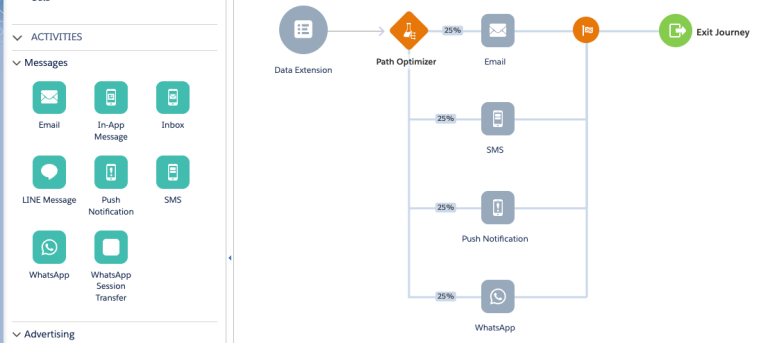
- Marketing Automation: Both platforms offer campaign automation and workflows. HubSpot has an easy workflow builder for email sequences, lead nurturing and sales handoffs. Salesforce provides Journey Builder, a drag‑and‑drop interface to automate cross-channel customer journeys (email, SMS, push, ads) at scale. SFMC’s Journey Builder is highly flexible (including decision splits, event triggers, Einstein AI scoring), but often requires training or coding for custom logic. HubSpot’s automation is generally more user-friendly; reviewers praise its “centralized platform [that] streamline[s] and optimize[s] marketing efforts” with no need for SQL or coding capterra.com.
- Email Marketing: Both support sophisticated email campaigns. HubSpot includes a drag‑and‑drop email builder, A/B testing, and personalization tokens. Salesforce MC’s Email Studio supports dynamic content via AMPscript and Einstein personalization. Both track deliverability and engagement. In G2 reviews, HubSpot’s email tools earn high marks for ease of use and templates capterra.com, while SFMC’s email is very powerful but can be complex (users cite “extensive automation” and deep segmentation as strengths) capterra.com.
- Segmentation & Personalization: HubSpot offers list segmentation based on contact properties, behaviors, and lifecycle stage, and its “smart content” adapts pages/emails to segments. Salesforce MC’s Audience Studio (part of Interaction Studio) can segment customers using unlimited data attributes and real-time behavior. HubSpot content can be personalized via tokens and rules without code, whereas SFMC often uses SQL queries or scripting for advanced segments. SFMC excels in highly granular, predictive segmentation (using AI), while HubSpot favors simpler GUI-based filters.
- Customer Journeys & Lead Management: Both platforms manage customer flows from lead generation through conversion. HubSpot integrates its Marketing Hub with its free CRM, so every campaign and contact history is unified. HubSpot provides tools like forms, landing pages, chatflows, and social to capture leads. SFMC integrates with Salesforce Sales Cloud or Account Engagement (Pardot) for lead data. A key difference: Salesforce Engagement (Pardot) is B2B-centric (lead scoring, account-based marketing), while HubSpot targets both B2B and B2C with cross-channel lead capture (including built‑in blogging and SEO tools for inbound). HubSpot natively includes blogs and SEO advice; SFMC lacks content hubs (users note “no landing pages, blogs, or SEO tools” without extra modules).
- Multichannel Marketing: Email and multichannel campaigns. SFMC supports true omni‑channel marketing: email, mobile SMS/push (via Mobile Studio), social ads (Advertising Studio), web personalization, and even IoT triggers when connected to Data Cloud. HubSpot covers email, social media posting/ads, live chat/chatbots, and SMS via add-ons. HubSpot’s platform also includes a CMS for website/blogs. According to HubSpot, SFMC Engagement “focuses primarily on mobile messaging (email, SMS, push)” and lacks built-in support for social, ads, or SEO hubspot.com. In practice, HubSpot lets marketers run ads and social campaigns from one dashboard, whereas SFMC requires separate Cloud (Advertising Studio) or integrations.
- CRM Integration: HubSpot includes its own CRM (free) that syncs contact and activity data across marketing, sales, and service by default. Salesforce MC is designed to integrate tightly with Salesforce Sales/Service Clouds. SFMC can sync data via Marketing Cloud Connect or Data Cloud, providing a unified customer profile if implemented. Businesses already using Salesforce CRM often choose SFMC for seamless data sharing capterra.com, while companies without a Salesforce ecosystem often prefer HubSpot’s all‑in‑one approach.
- Analytics & Reporting: HubSpot offers built-in dashboards for web analytics, campaign ROI, attribution, and sales metrics. Its dashboards and custom reports are user‑friendly and updated with each plan. SFMC’s native analytics (Marketing Cloud Analytics) report on email and journey metrics, and it can integrate with Tableau/Datorama for deep business intelligence. HubSpot’s site notes that SFMC requires premium add-ons (like Intelligence Reports) to get advanced dashboards. In Gartner-recognized terms, both provide robust analytics: “HubSpot…introduc[ed] more native channel publishing, embedded AI…and upgraded attribution reporting” ir.hubspot.com, while Salesforce promotes its Einstein Analytics in Marketing Cloud to deliver AI‑driven insights for campaigns salesforce.com.
- Personalization & AI: HubSpot has recently added AI tools (Breeze Copilot) for content and personalized messaging. It offers smart content modules that adapt to contact data, and a new AI-based “Content Assistant/Remix” for multi-channel campaigns. SFMC uses Einstein for predictive engagement scores and personalized send-time optimizations. HubSpot markets features like multi-touch revenue attribution and content AI that “Salesforce Marketing Cloud Engagement does not have” hubspot.com. In summary, SFMC can do very advanced personalization (e.g. dynamic journeys based on AI scores), but HubSpot’s AI enhancements make it competitive for SMB/midmarket users without heavy IT support.
Similarities and Differences
Both platforms are mature marketing automation suites, so they share many core functions (email campaigns, list management, analytics, etc.). Key similarities include campaign automation, reporting, and integrations. However, their approaches differ greatly: Salesforce MC is an enterprise-grade, channel‑agnostic platform that emphasizes flexibility and power, whereas HubSpot is an integrated inbound platform focused on ease-of-use and unified CRM. HubSpot users praise its usability and unified interface capterra.com, while reviewers note SFMC’s steeper learning curve and technical depth capterra.com.
For example, HubSpot’s site contrasts the two: SFMC “focuses primarily on…email, SMS, and push” and “can be challenging to use” for leads, lacking built-in landing pages or SEO tools. HubSpot, in contrast, is “complete…AI-powered” with social media, ads management, and easy reporting all in one platform. Gartner and review data reflect this: HubSpot Marketing Hub is rated very high for ease-of-use and extensiveness (G2: 4.4/5 g2.com; Capterra: 4.5/5 capterra.com) with comments on its intuitive interface. SFMC has solid but lower usability ratings (G2: ~4.0/5 g2.com; Capterra ease-of-use 3.8/5 capterra.com), with some users saying “the interface can be overwhelming…complexity requires significant training”.
* Analytics and insights. Both platforms offer rich reporting: HubSpot with built-in attribution and dashboards, SFMC with advanced AI analytics (Einstein) and integration to BI tools. In terms of features, HubSpot uniquely bundles content creation tools (blogs, landing pages, SEO recommendations) and free CRM. Salesforce Marketing Cloud’s strengths are in enterprise uses: extreme scalability, cross-product integrations (with Commerce Cloud, Service Cloud, Data Cloud, etc.), and specialized channels (like mobile push and Digital 360 tools).
Industry Suitability (Use Cases)
- B2B vs B2C: Salesforce Account Engagement (Pardot) and Marketing Cloud are traditionally strong in B2B, enterprise sales environments (finance, tech, manufacturing). HubSpot started in the SMB/B2B space, though now also serves mid-market/enterprise. Gartner names both as Leaders in B2B marketing automation (HubSpot Marketing Hub Leader for 2024 ir.hubspot.com; Salesforce Account Engagement Leader for 2024 salesforce.com). HubSpot tends to excel for companies emphasizing inbound marketing and full-funnel CRM-driven workflows, whereas large B2C or multi-brand organizations often use SFMC for broad campaigns.
- E-commerce and Retail: Salesforce explicitly targets retail/e-commerce with Marketing Cloud. Salesforce’s retail marketing page says SFMC lets “retailers create personalized, omnichannel customer experiences,” handling email, social, mobile messaging, advertising and loyalty programs salesforce.com. It integrates with Commerce and Loyalty Clouds for end-to-end commerce data. HubSpot can serve e-commerce businesses (Shopify/WordPress integrations, abandoned cart emails, etc.), but does not have built-in shopping or loyalty engines. For pure online retail, SFMC (tied to Commerce Cloud) often wins on deep integration and AI-driven recommendations.
- Small Business & Startups: HubSpot explicitly targets SMBs and startups. Its low entry cost (free/Starter), ease-of-use, and all-in-one approach suit businesses without large IT teams. HubSpot even has special programs for education and nonprofits. For example, “HubSpot for Education” markets the platform as “built to solve the needs of the education industry,” helping schools recruit applicants, track students, and engage donors. Nonprofits and agencies likewise use HubSpot’s free/discounted plans. Salesforce Marketing Cloud generally requires a bigger budget and implementation effort, so is less common in the small-business or non-profit sectors (unless heavily discounted).
- Nonprofits & Education: HubSpot offers free and reduced-cost licenses for nonprofits and education, and features like course-specific campaigns, alumni tracking, and donor management via its platform hubspot.com. Salesforce also has Education Cloud and discounted nonprofit programs, but Marketing Cloud’s complexity means schools often choose simpler tools for admissions/CRM. The HubSpot education site notes customers saw significant lead and deal growth using its platform hubspot.com.
In summary, HubSpot often fits SMBs, B2B companies, agencies, and inbound-focused teams (marketing-centric organizations). Salesforce Marketing Cloud shines in large enterprises (B2B or B2C), retail/e-commerce, financial services, healthcare, or any field needing highly customized, data-rich campaigns across many channels.
Regional Availability & Pricing
Both vendors operate globally, but pricing can vary by region/currency. Salesforce lists Marketing Cloud prices in USD, EUR, GBP, etc. For example, SFMC Growth Edition is ¥1,500/month in USD or €1,500 in Europe salesforce.com (interestingly the same numeric value, meaning Europe pays ~10% less in local currency). Advanced Edition is similarly priced at $3,250/€3,250. HubSpot’s pricing page (default USD) shows Marketing Enterprise at $3,600, while region-specific pricing is lower: e.g. UK Marketing Enterprise from £3,000 wise.com. HubSpot explicitly states its site can show different currencies wise.com.
In practice, European customers pay in EUR or GBP roughly 10–20% below the USD sticker price (reflecting exchange rates and local pricing policy). Additionally, EU users must consider VAT (HubSpot displays prices ex-VAT, Salesforce shows ex-tax for US/UK but may add VAT for EU billing). Feature availability is generally the same across regions, though support response times and local data hosting may differ (Salesforce and HubSpot each have EU data centers).
Customer Reviews & Expert Ratings
Third‑party reviews reflect these strengths and weaknesses. On G2, HubSpot Marketing Hub holds a ~4.4/5 rating (over 12,000 reviews) g2.com, with users citing its “user-friendly interface” and powerful integrated tools. Salesforce Marketing Cloud (Engagement) scores around 4.0/5 on G2 (~1,700 reviews) g2.com; on Capterra it shows 4.2/5 (524 reviews) capterra.com. Users praise SFMC’s feature depth and flexibility (especially for email segmentation and personalization) capterra.com, but many criticize its cost and complexity. For example, a Capterra review notes “to implement [SFMC], you have to pay staff or a partner a bunch of money” capterra.com.
In contrast, HubSpot reviewers often highlight ROI and ease-of-use. A Capterra analysis found HubSpot users value the “user-friendly interface and comprehensive suite of tools…managing multiple marketing activities…without needing separate tools” capterra.com. HubSpot’s dedicated CRM integration and all‑in‑one platform are repeatedly mentioned as advantages. Criticisms of HubSpot focus on pricing structure – advanced features require higher tiers, which can be expensive for small companies capterra.com.
Gartner’s Magic Quadrant for B2B MAP (2024) places both companies in the Leaders quadrant: HubSpot for its “easy-to-use, unified…front-office customer platform” ir.hubspot.com, and Salesforce (Account Engagement) for its scale and comprehensive toolset salesforce.com. Industry awards also reflect HubSpot’s usability focus (e.g. G2’s #1 marketing product for small business) and Salesforce’s enterprise pedigree (Salesforce is consistently ranked #1 CRM globally salesforce.com).
Ease of Use vs Strategic Fit vs TCO
- Short-Term Ease of Use: HubSpot generally offers a faster ramp-up. Its intuitive UI and bundled CRM mean teams can launch campaigns quickly capterra.com hubspot.com. Salesforce MC often requires more setup (data schema, integrations, possibly coding), so initial deployment is slower. HubSpot’s setup is less technical and often done in-house; SFMC implementations frequently involve consultants or developers.
- Long-Term Strategic Fit: Over time, SFMC’s depth can be a strategic advantage for data-driven enterprises. It can handle complex, multi-team workflows and integrate with the full Salesforce ecosystem (Service, Commerce, IoT, etc.). HubSpot’s strategic fit lies in its unified platform: marketing, sales, and service run on one codebase with one database. Companies that value “one source of truth” and inbound-driven growth often favor HubSpot’s holistic model hubspot.com.
- Total Cost of Ownership (TCO): HubSpot’s TCO is transparent and primarily subscription-based (plus any add-ons like extra contacts or agencies). Over time, costs can rise with additional hubs (Sales, Service) or contacts, but no hidden tiers or mandatory services. SFMC’s TCO can be higher: beyond license fees, many customers pay for premium support, data storage add-ons, and consulting/maintenance. HubSpot’s site warns that Salesforce pricing is “layered with add-ons” (Data Cloud, premium support, advanced features) hubspot.com. In the long run, SFMC usually has a higher financial and resource commitment, but for enterprises needing its capabilities, it can yield high ROI.
Key Similarities and Differences (Summary Table)
| Feature/Aspect | Salesforce Marketing Cloud | HubSpot Marketing Hub |
|---|---|---|
| Pricing Model | Flat fee (per Org) at high tier ($1,500+†/mo). No free tier. | Per-seat and per-“marketing contact”; free/Starter tiers available. |
| Target Customer | Mid-market to enterprise (large orgs in retail, finance, tech). | Small to large (emphasis on SMBs/Midmarket); also used by enterprises. |
| Deployment & Ease | Complex setup; often needs technical team/partner. | Fast deployment; friendly UI for non-technical marketers. |
| Channels Supported | Extensive: Email, Mobile (SMS/Push), Social ads (via modules), Web, IoT, etc. | Broad: Email, Social publishing/ads, SMS (add-on), live chat, plus built-in CMS/blog. |
| Automation Tools | Journey Builder for advanced cross-channel campaigns; needs expertise. | Workflows for email/sequences/lead routing; no coding needed. |
| CRM Integration | Native with Salesforce CRM (Sales/Service Clouds). | Built-in free CRM; also bi-directional sync with Salesforce (optional). |
| Segmentation & Personalization | AI-driven segments (Einstein) and scripting for dynamic content. | Segmentation lists in UI; personalization tokens and smart content. |
| Content/Inbound Marketing | Focus on messages; no native blogging/SEO. (Content Cloud separate). | Includes blogging, SEO tools, landing pages, and full inbound toolkit. |
| Analytics & Reporting | Advanced (Einstein Analytics, Tableau/Datorama integration). | Built-in dashboards, attribution, custom reports (at higher tiers). |
| AI and Special Features | Einstein AI for send-time, recommendations, and Einstein Messaging. | New AI tools (Breeze) for content creation, attribution, and multi-touch analytics. |
| Support & Ecosystem | Large partner ecosystem; extensive apps via AppExchange. | 1600+ apps in marketplace; HubSpot solutions partners; academy training. |
| Typical Use Cases | Enterprise marketing; omnichannel customer journeys; retail/e-commerce campaigns. | Inbound marketing; lead generation/nurturing; SMB/midmarket sales and marketing. |
| Ease-of-Use (User Ratings) | Moderate (G2 ~4.0/5; Capterra ease ~3.8/5 capterra.com). | High (G2 ~4.4/5; Capterra 4.5/5 g2.com capterra.com). |
† Growth Edition price; Advanced is ~$3,250/mo.
Sources:
– Official product/pricing pages salesforce.com hubspot.com, vendor blog/press releases ir.hubspot.com hubspot.com, and independent reviews (G2, Capterra) g2.com capterra.com.
Summary / Conclusion
HubSpot Marketing Hub and Salesforce Marketing Cloud both deliver powerful marketing automation capabilities, but they serve distinct audiences and strategic needs. HubSpot excels in usability, rapid deployment, and its unified CRM-driven ecosystem – features that make it ideal for SMBs, mid-market teams, and organizations that prioritize inbound marketing, centralized tools, and predictable cost structures. Its increasing investment in AI and native content tools strengthens its position as a scalable marketing platform that minimizes technical overhead.
Salesforce Marketing Cloud, by contrast, is purpose-built for enterprises with complex data models, large marketing teams, cross-cloud Salesforce deployments, and sophisticated multichannel engagement requirements. Its flexibility, extensibility, and AI-driven personalization offer significant long-term value – but typically demand higher budgets, specialized expertise, and professional implementation support.
In short:
Choose HubSpot if you need an intuitive, all-in-one platform that unifies marketing, sales, and service with minimal technical friction.
Choose Salesforce Marketing Cloud if you require enterprise-level orchestration, deep Salesforce CRM integration, and advanced omnichannel automation at scale.
Both platforms are industry leaders – and the right choice ultimately depends on your organization’s size, digital maturity, internal capabilities, and strategic marketing priorities.