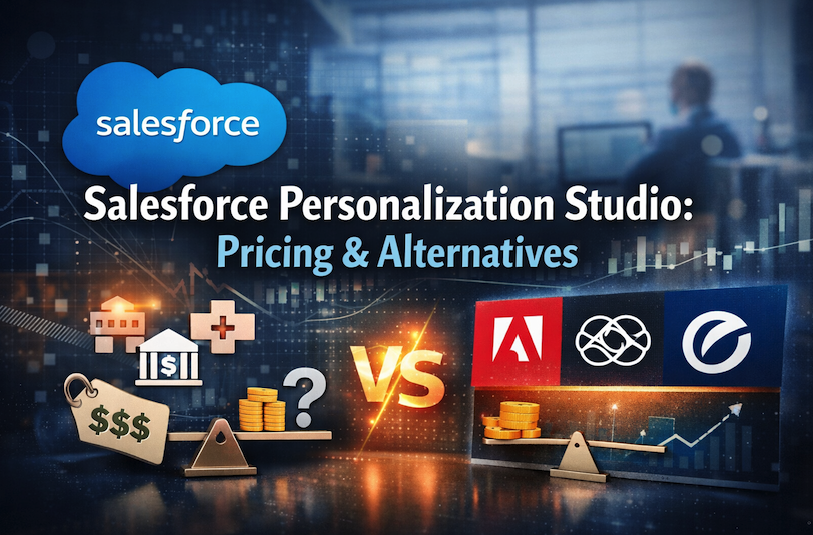
Salesforce Personalization Studio (Interaction Studio) – In-Depth Analysis

Salesforce Personalization Studio (formerly Interaction Studio) is positioned as an enterprise-grade personalization engine designed for organizations with complex customer journeys, high digital traffic, and advanced data maturity. While its capabilities are powerful, it is not a universal fit. Understanding who benefits most, how pricing scales, and where alternatives may be more appropriate is essential before making a strategic investment.
This section examines the industries and roles best aligned with Personalization Studio, outlines Salesforce’s pricing tiers and common add-ons, identifies scenarios where the platform may be excessive, and compares it with leading personalization alternatives inside and outside the Salesforce ecosystem. The goal is to provide a pragmatic, decision-oriented view rather than a feature-only comparison.
Target Audience & Industry Fit
Retail
E‑commerce and omnichannel retailers are prime users. Roles include digital marketing managers, e‑commerce/product managers, CRM/loyalty leads, and data analysts. These teams use Personalization Studio to deliver tailored product recommendations, promotional offers, and individualized shopping experiences on websites, mobile apps, and email campaigns. For example, large fashion or electronics retailers automate post-purchase emails and related-product suggestions to increase engagement.
Finance
Banks, insurers, credit unions and wealth managers benefit by personalizing customer communications. Marketing directors and customer experience teams use it to send targeted loan/credit offers, insurance quotes, or investment recommendations based on customer behavior and profile segments. For instance, financial services firms create calculated-insight segments to deliver financial planning tips and relevant product offers at scale.
Healthcare
Patient engagement and communications teams in hospitals, clinics, payers or pharma use Personalization Studio to tailor patient/payer outreach. By unifying patient data (portal activity, demographics, treatment history), they push relevant content like appointment reminders or education materials. As one analysis notes, “Marketing Cloud Personalization empowers healthcare organizations to deliver relevant and timely information to patients, enhancing patient engagement by harnessing first-party data”. Typical roles include healthcare marketers, patient experience managers, and digital directors who use it to improve adherence (e.g. targeted wellness campaigns) and satisfaction through personalized web and email experiences.
Each of these industries has high digital engagement and complex product sets, so roles focused on personalization (e.g. marketing managers, digital CX leads, data analysts) stand to gain the most from Personalization Studio’s real-time, cross-channel capabilities.
Pricing Tiers
Salesforce publishes two main Personalization Studio (Marketing Cloud Personalization) editions:
- Growth Edition: $108,000 USD per org/year (billed annually) salesforce.com. Includes real-time web, email, and mobile app personalization with features such as segmentation and rule‑based decisioning, A/B/N testing, and AI-driven product/content recommendations salesforce.com.
- Premium (Enterprise) Edition: Contact Salesforce for pricing (industry sources indicate on the order of ~$300K/year for large deployments g2.com). Adds advanced AI features beyond Growth: agent‑force/Einstein decisioning and objective-driven next-best-offer logic, expanded throughput (e.g. app/mobile personalization at scale), plus premium support. Its feature list covers all Growth functions plus things like mobile app personalization, Agentforce-driven decisioning, and AI objective-based recommendations salesforce.com. Because Premium pricing is custom (quote-based), Salesforce directs customers to sales.
Relevant Add-Ons:
- Data Cloud (Customer Data Platform): Often paired with personalization to unify customer data from across systems. The Data Cloud for Marketing (Starter) edition is $108,000 USD/yr. It provides identity resolution and unified profiles needed for advanced personalization.
- Marketing Cloud Engagement: (Email/Journeys) is a complementary product (separate subscription starting around $1,250/org/month for entry-level plans). Not strictly an add-on to Personalization, but commonly used in tandem for multi-channel campaigns.
- Other add-ons (SMS/WhatsApp credits, additional AI/data credits) are available per use. Many costs above are list prices; actual contract pricing may vary.
Who Would Not Benefit
- Very Small Companies or Startups: Organizations with limited budgets or low digital traffic often find the platform cost-prohibitive g2.com. Reviewers note that the “pricing may be high for smaller businesses” and the total cost of ownership (including consultants or developers) is steep g2.com. Small teams without specialized marketing/IT support may struggle to justify the investment.
- Minimal Web/App Presence: Companies whose customer engagement is mostly offline (e.g. small brick‑and‑mortar shops, heavy industrial suppliers) gain little from an advanced real-time personalization engine. If you have few online visitors or only a static brochure site, a full Personalization Studio license brings little incremental value.
- Simple Use Cases: Firms that need only basic segmentation or drip email campaigns (versus true 1:1 contextual recommendations) often don’t need the complexity. The platform’s steep learning curve and integration requirements g2.com mean it’s overkill for campaigns that could be handled by simpler email or analytics tools. In summary, businesses with constrained budgets, low data volume, or lack of digital marketing resources are unlikely to benefit from Salesforce Personalization Studio’s rich (and expensive) feature set g2.com.
Alternatives & Comparison
Both within and outside Salesforce, several platforms offer personalization/A/B‑testing capabilities. Key alternatives include:
| Platform / Edition | Provider | Pricing (≈) | Key Features | Ideal Use Cases |
|---|---|---|---|---|
| Salesforce Personalization Studio (Growth) | Salesforce | $108K/yr (Growth); | – Real-time personalization on web/email/app; segmentation & rule-based targeting; A/B/N testing; AI-driven product/content recommendationssalesforce.com. | Omnichannel B2C brands needing rich 1:1 personalization (e.g. large retailers, travel companies). |
| Salesforce Personalization Studio (Premium) | Salesforce | Quote (≈$300K/yr) | – All Growth features plus mobile app personalization, Agentforce/Einstein decisioning, objective-based AI offers salesforce.com. Enterprise-scale deployments requiring advanced AI-driven recommendations. | |
| Adobe Target (Standard/Premium) | Adobe | Custom (quote) | – A/B/multivariate testing; rule-based & automated personalization; geo/segmentation targeting; product/content recommendations (Premium includes automated personalization via AI) helpx.adobe.com. | Enterprises (esp. using Adobe Analytics/Experience Cloud) needing robust optimization and onsite personalization. |
| Oracle Maxymiser | Oracle (CX Suite) | Custom (quote) | – A/B & multivariate tests; advanced targeting/segmentation; real-time personalization and product recommendationsoracle.comoracle.com. | Large brands (retail, finance, travel) wanting deep on-site optimization integrated with Oracle marketing stack. |
| Optimizely Web Experimentation | Optimizely | Custom (quote) | – Robust A/B/n and feature flag experimentation; personalization via AI-powered recommendations; analytics; multi-channel campaign testing g2.com. | Digital-focused teams (midmarket to enterprise) emphasizing iterative testing and conversion optimization. |
| Dynamic Yield | Mastercard | Custom (quote) | – Unified personalization platform: audience segmentation & management; deep-learning product/content recommendations; A/B testing; personalized web, email & app campaigns; triggered messaging and offers mastercardservices.com. | Retail, travel/hospitality, financial services brands seeking advanced ML-driven personalization at scale. |
| Monetate | Kibo (Monetate) | Custom (quote) | – AI-driven product recommendations and personalized site search; A/B/n testing; dynamic bundling; segmentation/targeting; actionable analytics monetate.com. | eCommerce and retail companies focused on merchandising and conversion (top 1000 retailers). |
| Insider | Insider (SaaS) | Custom (quote) | – AI-native cross-channel personalization & marketing automation; integrated CDP for unified 360° profiles; predictive AI (“Sirius AI”) for segmentation; omnichannel campaigns (web, mobile, email, push, WhatsApp, etc.) useinsider.com. | Mid-market to enterprise brands looking for broad campaign orchestration with personalized customer journeys. |
Within Salesforce Ecosystem: For simpler cases, Salesforce offers lighter personalization options. For example, Commerce Cloud Einstein provides on-site product recommendations for e‑commerce, and Marketing Cloud Engagement (Einstein) offers basic predictive email/content recommendations. However, these lack the full real-time, cross‑channel segmentation of Personalization Studio.
Pricing Notes: Most enterprise personalization tools (Adobe Target, Oracle Maxymiser, Optimizely, etc.) are custom-priced by quote, often reflecting traffic volume or usage. Salesforce’s Growth edition is published at $108K/yr salesforce.com, making it one of the few with a listed price; Premium and add-on pricing require direct sales engagement.
Sources:
– Salesforce documentation and pricing pages salesforce.com salesforce.com;
– industry consultant reports and reviews revelyconsulting.com silverlinecrm.com g2.com g2.com;
– product descriptions for Adobe Target helpx.adobe.com, Oracle Maxymiser oracle.com oracle.com, Dynamic Yield mastercardservices.com, Monetate monetate.com, Insider useinsider.com useinsider.com, etc.
Conclusion
Salesforce Personalization Studio is best suited for large, digitally mature organizations – particularly in retail, financial services, and healthcare – where real-time, cross-channel personalization directly impacts revenue, engagement, and customer experience. For teams with strong data foundations, sufficient traffic volume, and dedicated marketing and technical resources, it can deliver significant value through 1:1 contextual experiences at scale.
However, its high cost, implementation complexity, and learning curve make it a poor fit for smaller organizations, low-traffic digital properties, or use cases limited to basic segmentation and email automation. In such scenarios, lighter Salesforce-native tools or third-party personalization platforms may offer a better balance of capability and cost.
Ultimately, selecting Personalization Studio should be driven by business maturity and strategic ambition – not just feature depth. When aligned correctly with organizational needs, data infrastructure, and long-term personalization goals, it becomes a powerful differentiator. When misaligned, it risks becoming an expensive underutilized asset.
Care and share.